
The Interface Engine is a full-featured environment for all your HL7® needs.
TIE: HL7 Interface Engine
The Interface Engine (TIE) is a complete middleware package focused on implementing the healthcare information exchange standards defined by HL7 International, both Version 2.x messaging and Clinical Documents (CDA). TIE (formerly known as HL7Connect) is both powerful and easy to use. TIE manages messages and documents, and exchanges them using a wide variety of transport mechanisms. In addition, you can build integration using VBScript or Javascript, or any DotNet or COM capable language, or use TIE from your own application. Download a trial and find out why it is your best choice today.
HL7® and CDA are the registered trademarks of Health Level Seven International
Product Details
Download a free, 30-day evaluation of TIE – The Interface Engine. (When you buy a full license, you can retain your setup.) The evaluation version does not support configuration packaging & replication, but is fully featured in all other regards. Included in evaluation download package:
- TIE Interface Engine
- TIE SDK:
- COM Library
- TIE Developer
- Extensive Documentation
- MySQL Community Server, useful if a database doesn’t already exist
- Mobile Phone Clients
TIE comes in several different editions so that we can best accommodate your needs. All Editions have the same application features except as noted below. Note that editions may be purchased with or without CDA support. Editions purchased without CDA support will be missing most, but not all, CDA related features. Licenses are valid for the life of the software. The cost to upgrade from one edition to another is the difference between their current prices.
| Enterprise | This is the full unrestricted version of TIE. It can support any number of interfaces, up to the amount feasible given the system resources available, and supports message exchange by COM/web services. The Enterprise Edition is the only Edition that supports running on a Windows Cluster. | $4,500 |
| Enterprise +CDASupport | Exchanges XML-based documents like CCDs and C-CDAs in addition to HL7v2 messages. | $9,500 |
| Select10 | This is a restricted version that will only support up to 10 active interface connections at a time, will not run on a Cluster, and will not exchange messages through COM/Web services. | $1,500 |
| Select10 +CDASupport | Exchanges XML-based documents like CCDs and C-CDAs in addition to HL7v2 messages. | $3,000 |
| Developer | A desktop application that includes the full TIE functionality. This is a must-have tool for use by application developers who are implementing either TIE v2 or CDA solutions, even when the solution will be implemented on other interface engines. | $500 |
- Support for all released HL7 versions from v2.1 to v2.7
- Full support for v2.xml encoding
- Support for v2 localization using z-segments, and even support for re-defining the HL7 standard if necessary
- Support for CDA R2
- Support for CCD
- Support for CDA extensions using alternate namespaces
- Messages and documents are stored in a transaction-safe database (Microsoft SQL Server or MySQL)
- They can be stored as long as desired, or alternatively archived or deleted after a configurable interval of time since receipt
- They can also have annotations attached which can be used to manage the workflow (see below)
- TIE stores audit information relating to interface status, user history, and a full history for messages and documents, including resending failures
- Support for all released HL7 versions from v2.1 to v2.7
- Full support for v2.xml encoding
- Support for v2 localization using z-segments, and even support for re-defining the HL7 standard if necessary
- Support for CDA R2
- Support for CCD
- Support for CDA extensions using alternate namespaces
- TIE supports many network protocols:
- MLLP: TIE’s Minimal Lower Layer Protocol (v2 messages)
- XDR: IHE’s Cross-Enterprise Document Transfer protocol. (CDA documents)
- HTTP: Several variations of how to use HTTP, principally a simple RESTful based POST protocol
- Email: A simple email transfer protocol
- TIE also supports file based transfer using a variety of file formats:
- Plain Text (with scripts to convert the format)
- CDA documents – one per file
- HL7- one message per file
- HL7 v2 Batch file format
- LLP dump format
- Alternatively, you can use the COM library to exchange messages or documents between your application and TIE, or you can use the web services interface. In addition, it’s possible to write a custom DLL to handle message and document exchange
- Utilize a variety of scripting languages to create, validate, manipulate or modify messages and documents or modify and control the workflow.
- Interact with other databases or applications and insert information into the messages or insert data into a database using SQL statements.
- TIE supports a number of scripting languages:
- Javascript
- VBScript
- XSLT
- KScript (TIE scripting language for generating HL7 and CDA documents)
- TIE can validate messages and documents interactively, or as part of the workflow
- TIE supports a number of validation approaches:
- Basic Validation against the standards
- Javascript/VBScript
- XML Schema
- XSLT
- OCL (Object Constraint Language)
- (CDA) Eclipse OHF validation
- TIE includes a full knowledge base that provides:
- a full copy of HL7 v2 definitions (all versions: structures, events, segments, structures, and datatypes)
- a full copy of the CDA definitions (CDA clones, RIM classes and attributes, and datatypes)
- LOINC definitions and classifications
- SNOMED-CT terms and relationships
- These knowledge resources are available through the system as appropriate, for example performing message and document routing based on Snomed-CT subsumption logic
- A web-based user interface can be used from any web client, including mobile phones.
- Custom mobile phone applets are included for ease of remote management.
- An interactive development environment for working with HL7 v2 messages, CDA documents, and developing and testing scripts for the TIE extensibility features
TIE includes a COM library. The COM library offers a set of TIE v2 messaging and CDA document services that are useful for healthcare applications. The services include message/document:
- Parsing
- Encoding
- Building
- Scripting
- Analysis
Licensing
No license, either developer or run-time, is required to use the COM Library. It is free for any of kind of use. The COM library and a standalone COM Library installer is included in any installation of TIE, and can be installed separately.
Server Support
The TIE COM Library can be configured to connect to the TIE server at startup. In this mode, the COM Library offers an additional series of services that are extensions of the TIE server itself, most importantly including the ability to send and receive messages or documents. The server needs to have an Enterprise Edition License for this use.
In addition, the TIE Type Library includes a number of server side interface declarations. TIE users can implement these interfaces in any COM-capable language, and handle message/document sending/receiving and other TIE extensibility events in their own code.
TIE provides the following features to support HL7 v2 messaging:
TIE includes a COM library. The COM library offers a set of TIE v2 messaging and CDA document services that are useful for healthcare applications. The services include message/document:
- Parsing
- Encoding
- Building
- Scripting
- Analysis
Licensing
No license, either developer or run-time, is required to use the COM Library. It is free for any of kind of use. The COM library and a standalone COM Library installer is included in any installation of TIE, and can be installed separately.
Server Support
The TIE COM Library can be configured to connect to the TIE server at startup. In this mode, the COM Library offers an additional series of services that are extensions of the TIE server itself, most importantly including the ability to send and receive messages or documents. The server needs to have an Enterprise Edition License for this use.
In addition, the TIE Type Library includes a number of server side interface declarations. TIE users can implement these interfaces in any COM-capable language, and handle message/document sending/receiving and other TIE extensibility events in their own code.
TIE provides the following features to support CDA Documents:
- Store and forward, or straight-through sending of documents
- CCD api to make reading CCD documents easier (native expression in CCD language)
- Modification of documents using VBScript or Javascript
- Validation of documents using schema, transforms, OCL, VBScript, Javascript, or the Eclipse OHF CDA validator.
- Exchange using XDR (IHE XSD.b protocol), HTTP RESTful post, as files
- Inbuilt dictionary of the CDA & v3 standard to provide metadata throughout the product
Installation and Technical Guide
TIE Consulting
The Dynamic Health IT team has extensive expertise in all domains of HL7 and has supported hundreds of interfaces and implementations of TIE worldwide. We customize our consulting services to suit your needs and budget, from complete HL7 outsourcing to as-needed support, troubleshooting and mentoring.
To receive a free quote for any of your HL7 or TIE consulting and training needs, please email:
Real-World Interface Experience
TIE isn’t sold as a shrink-wrapped product you’re left to configure alone. Dynamic Health IT’s team has hands-on experience building and supporting production HL7 interfaces — including custom message routing, crosswalk tables, and automated failure alerting for live hospital go-lives. When you license TIE, you get an engine backed by people who have actually run it in the field, not just documented it.
Features
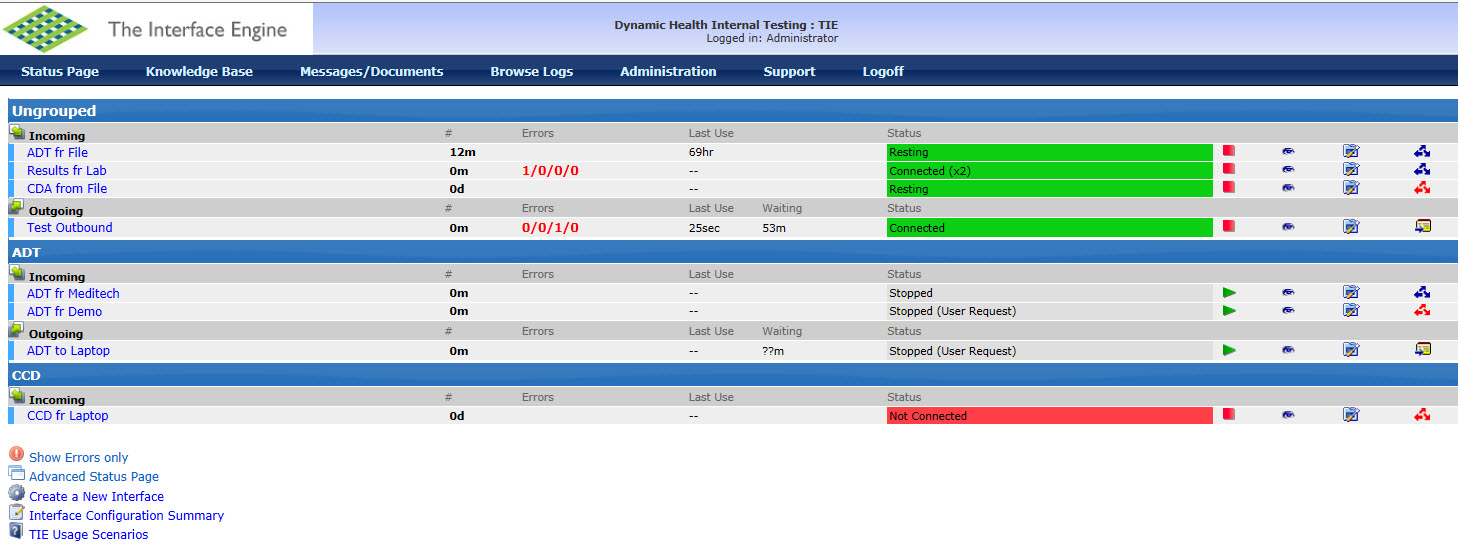
- Simple browser-based screens for developing, maintaining and monitoring interfaces
- Facilitates easy management of HL7 feeds using TCP/IP, web services, FTP and file-based protocols
- Converts between HL7 and other data formats, such as CCDA, CCD and CCR Clinical Documents, XML, fixed or delimited files and ANSI X-12
- The message editor enables viewing, downloading, tabulation and re-transmission of stored messages – both raw and interpreted
- Processes incoming messages for storage, routing, validation, and manipulation.
Use Cases
Bi-Directional HIE Connections
ConnectEHR creates C-CDAs and TIE securely transports XML via XDS to HIEs. If your EHR creates C-CDAs, TIE can send them to Healthix or Lanes via XDS.
HL7v2 Transformation
One-to-many and many-to-one message routing using all major messaging protocols. Transform, map, and transport virtually any HL7 message type.
Connecting to Health Information Exchanges (HIEs)
TIE connects hospitals, practices, and EHRs to regional and state Health Information Exchanges (HIEs). Using IHE cross-enterprise profiles such as XDS.b and XDR, TIE can submit clinical documents to an HIE and exchange data in both directions.
Whether your source systems produce C-CDA/CCD documents or HL7 v2 messages, TIE transforms them into the format the HIE expects and transports them securely. For example, TIE packages C-CDAs and sends them via XDS to exchanges such as Healthix and LANES, and it can route ADT event notifications and results feeds into HIE and provider workflows.
- Bi-directional HIE connectivity using IHE XDS.b and XDR profiles
- Submit and exchange C-CDA, CCD, and CDA R2 documents
- Convert HL7 v2 messages (ADT, ORU, and more) to the formats HIEs require
- Secure transport over XDR, Direct, HTTPS/REST, and MLLP
- Proven connections to exchanges including Healthix and LANES
TIE: Frequently Asked Questions
What is an HL7 interface engine?
An HL7 interface engine is middleware that sits between healthcare systems and manages the translation, routing, and validation of clinical data. Without an integration engine, each system would require a custom point-to-point connection, creating an unmanageable web of interfaces. TIE acts as the central hub, ensuring every system speaks the same language.
What protocols and file formats does TIE support?
TIE supports message exchange over MLLP (its Minimal Lower Layer Protocol for HL7 v2 messages), XDR (IHE’s Cross-Enterprise Document Transfer protocol for CDA documents), HTTP/REST, and email. It also supports file-based transfer in plain text, CDA (one document per file), HL7 v2 (one message per file or full batch format), and LLP dump format.
Does TIE support CDA and CCD documents, or just HL7 v2 messaging?
Both. TIE supports the full range of released HL7 v2 versions (v2.1 through v2.7, including v2.xml encoding) as well as CDA R2 and CCD documents, with support for CDA extensions using alternate namespaces.
Is there a free trial?
Yes. TIE offers a free, fully-featured 30-day evaluation download, with the only exception being that configuration packaging and replication are not included in the trial. If you purchase a full license afterward, you can retain your evaluation setup.
What editions and licensing does TIE offer?
TIE comes in several editions to fit your needs and budget — Developer, Select10, and Enterprise — each available with or without CDA support, ranging from $500 to $9,500. Licenses are valid for the life of the software, and you can upgrade between editions later for the difference in price. See the Pricing tab under Product Details above for full specifications.
Can TIE connect to a Health Information Exchange (HIE)?
Yes. TIE provides bi-directional connectivity to regional and state Health Information Exchanges. Using IHE profiles such as XDS.b and XDR, it can submit and exchange C-CDA/CCD documents and HL7 v2 feeds with an HIE — for example, packaging C-CDAs and sending them to exchanges like Healthix and LANES via XDS. TIE handles the transformation and secure transport so your EHR can both contribute to and receive data from the exchange.
Can I customize or extend TIE?
Yes. TIE is highly extensible through scripting — you can create, validate, transform, and route messages and documents, or control workflow, using JavaScript, VBScript, XSLT, or TIE’s own KScript. You can also read from and write to external databases and applications via SQL, or drive TIE from any COM-capable language using the included COM library.
What support and consulting does Dynamic Health IT provide?
TIE is backed by the Dynamic Health IT team, which has built and supported hundreds of HL7 interfaces and TIE implementations worldwide. We offer consulting, training, and support tailored to your needs and budget — from complete HL7 outsourcing to as-needed troubleshooting and mentoring.
Looking for software? Support and Training?