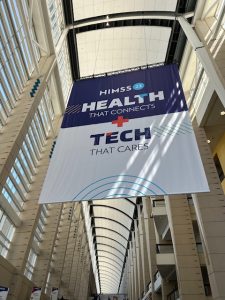
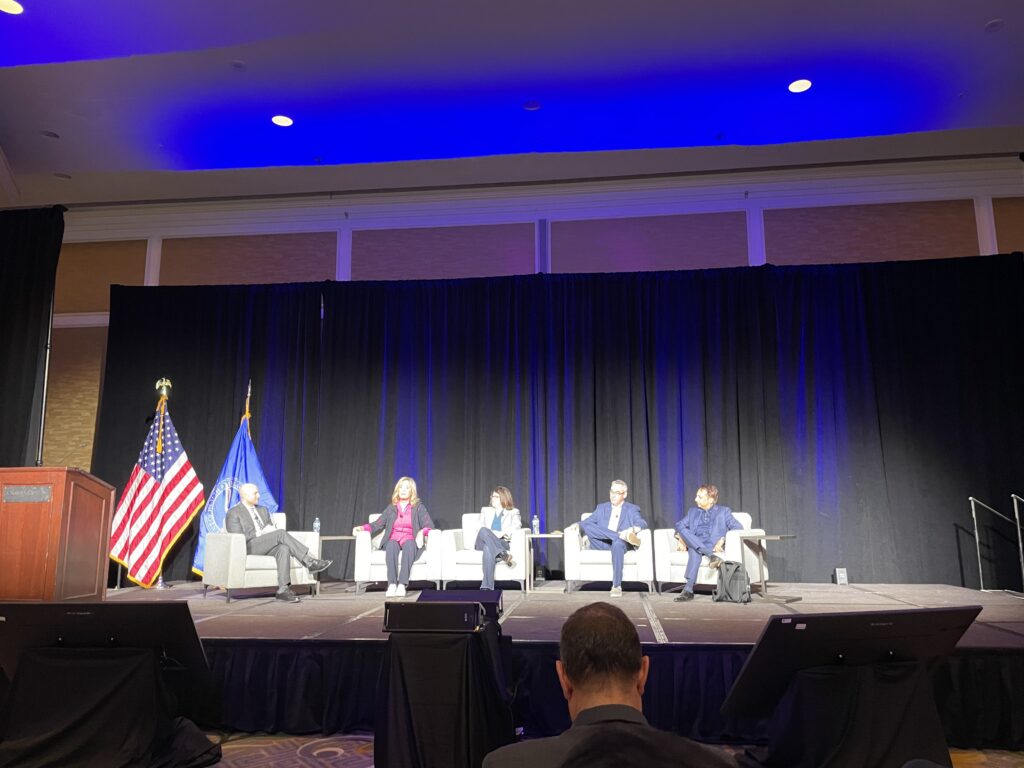
Landing in Washington, D.C. always carries a certain weight. They say a place contains everything that’s ever happened in it, and in D.C., that means centuries of decisions, debates, and defining moments. It’s hard not to think about the Founding Fathers and the origins of the country, though I’m fairly certain they wouldn’t recognize the Office of the Assistant Secretary for Technology Policy, and might even oppose its existence. Still, this is where the rules are written. And for those of us working in Health IT, it’s a privilege to be in the room when the conversations happen.
That sense of history felt especially fitting after a panelist, making the case for shifting care back into the home to reduce costs, let slip the old trope: what’s old is new again. Hard to argue. So I ditched the Waymos, took the Metro, and walked when I could.
A session with Priyanka Agarwal from HealthEx, a platform that lets individuals instantly and securely access and share their health records, pointed the crowd to a piece on the speed of AI written by Matt Shumer. Much of the conference focused on whether we were moving fast enough to “fix” the healthcare system, with Amy Gleason putting it bluntly:
“This is still broken. How is this still broken?”
If Matt’s article turns out to be foreshadowing instead of hysteria, Amy might get her wish sooner than she expected, and I’ll be in for a short career.
I thought about something Ralph Waldo Emerson wrote: “Society never advances; it is just amelioration. Whatever it gains on one end, it loses on another.” As we race to fix today’s friction — interoperability, manual clinical notes, prior authorization — what are the problems of tomorrow we are inadvertently creating?

The Push for Price Transparency
One of the more fiery discussions happened after the keynote remarks from Tom Keane (unfortunately, I couldn’t come up with any 6/7 jokes for this blog) during the panel discussion, “Health Technology for Transparency and Affordability”. Cynthia Fisher of PatientRightsAdvocate.org insisted that we needed to “pull back the curtain” on insurance pricing. She highlighted that not only would consumers have more power, but so would employers. For too long, friction has been a feature, not a bug, for the industry’s biggest players.
Fisher cited several recent legal actions around claims data, including disputes involving Johnson & Johnson, Kraft Heinz, Aramark, and the State of New Jersey’s action against Horizon Blue Cross, as signs that the tide may be turning.
Her plea to the room was simple: actually read your insurance contracts. As long as processes stay complicated and opaque, consumers will find it hard to win. If we want to unleash real competition on price and quality, we have to pull back the curtain on insurance pricing.
If that sounded entertaining and you’d like to watch, a recording can be found here – https://player.vimeo.com/video/1166004510
Prior Authorization: Definitely Not There Yet
The Prior Authorization listening session involved many different stakeholders who had much to say. I don’t envy a legislator’s job, parsing so many different, often competing, deeply entrenched interests. One speaker was eager to remind the room that, ultimately, the focus should be the patient’s experience: a window into the authorization process including clear reasons for denials, transparency into how decisions are made, and a simple electronic appeal button.
The Implementation Guides (IGs) have been published, but passing a certification test is not the same as being production-ready. Industry veterans pointed out that highly complex prior authorizations simply don’t map well to current IGs. “Mandating something that doesn’t work will never get us to something that does.” It was stressed that workflows need to be refined before we put this in clinicians’ hands, otherwise we’ll bake resentment into the rollout. Concerns surfaced across the board including provider networks, clearinghouses, EHR vendors, and payers’ readiness.
Passing Inferno validates conformance, but it does not validate real-world payer connectivity, network routing, response-time SLAs, or exception handling.
Dynamic Health IT is currently developing our FHIR-based Prior Authorization workflow, targeting late Q3 for certification readiness with an initial emphasis on Medicare connectivity.
TEFCA
Tom Keane’s keynote opened with a milestone: nearly 500 million health records have now been exchanged through TEFCA, up from roughly 10 million at the start of 2025.
For those less familiar, TEFCA (the Trusted Exchange Framework and Common Agreement) is the national framework that connects disparate health information networks under one set of rules, standards, and governance. The idea is simple: instead of every provider, payer, and health system negotiating point-to-point connections and signing separate legal agreements, they connect once through a Qualified Health Information Network (QHIN) and gain access to the whole. Eleven QHINs are now designated, with over 71,000 organizations participating nationwide.
It’s worth noting that the current exchange through TEFCA is document-based. Records are exchanged as CDA and C-CDA XML documents, not native FHIR resources. That’s an important distinction as the industry continues its longer migration toward FHIR-based workflows.
DHIT is partnered with KNO2, a designated QHIN. We are working to move FHIR into the QHIN workflow for our EHR partners, using FHIR in the query process to check for existing data, while bridging to the document-based exchange that TEFCA currently supports.
As participation scales, the next challenge is ensuring the right data is findable, accurate, and actionable at the point of care. That work is still ahead of us.
AI: Trust vs. Trajectory
AI talk was everywhere this year, but the gap between trajectory and trust was a recurring theme. Matt Pavelle from Doctronic shared that his platform has now processed 22 million AI consults, with a 99.2% agreement rate compared with clinicians.
Michelle Tarver, who serves as the Director of the Center for Devices and Radiological Health under the FDA, was candid about why adoption is slower than the technology’s pace might suggest: clinicians and patients still don’t trust AI outputs.
Investment in Digital Health
At a panel including representatives from Rock Health, Ziegler, HSBC, and Boston Consulting Group, several investors suggested the traditional SaaS model in digital health, and technology companies as a whole, may be fading. Whether that shift materializes fully remains to be seen, but there is no denying we are in for a shakeup as AI companies now have flatter margins.
I read a comparison that the software business is now akin to the restaurant industry. Dust off the aprons and sharpen the knives. As barriers to entry decrease, the fight for capital will intensify. Midi Health was highlighted as a startup that was able to catch the eye of some financiers.
A Changing Care Landscape
Several speakers highlighted structural changes reshaping how and where care is delivered: facility contraction, ongoing provider shortages, the growth of home-based care, and the proliferation of connected medical devices. Regulators emphasized that oversight should match risk, high-risk clinical tools require review, while low-risk wellness devices (your Garmin watch) may not.
The future increasingly looks like device-driven care management at home, with those devices communicating directly to providers through standardized identifiers and FHIR-based workflows.
So… Are We There Yet?
Not quite.
But the tone of this meeting suggested something important: there’s less debate about what needs to happen, and more focus on how to actually make it work. Price transparency for insurance is coming. Consumer data access is expanding. AI is accelerating. Prior authorization is under real pressure to change.
Both Priyanka from HealthEx and Steve Posnack were eager to suggest we are close to something, with Priyanka describing it as “a great moment” and Steve using a movie-montage metaphor of a hand reaching down and lifting the protagonist out of the mud.
At Dynamic Health IT, we’ve watched this industry evolve from basic Meaningful Use to the complex, AI-driven landscape we’re entering now. And we are excited to evolve with it.
Now, if you’ll excuse me, I have some insurance contracts to read.