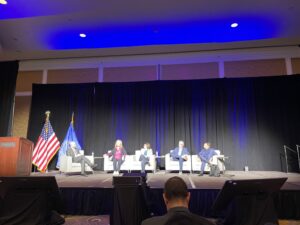

On Thursday, November 13th, 2025, the Dynamic Health IT (DHIT) team traveled to Washington, D.C., to attend the CMS Health Tech Ecosystem Connectathon, joining health tech leaders, policymakers, and innovators from across the industry.
Beyond the buzzwords, we saw a landscape teeming with innovation, frustrating bottlenecks, and opportunities for AI.
CMS Pledge
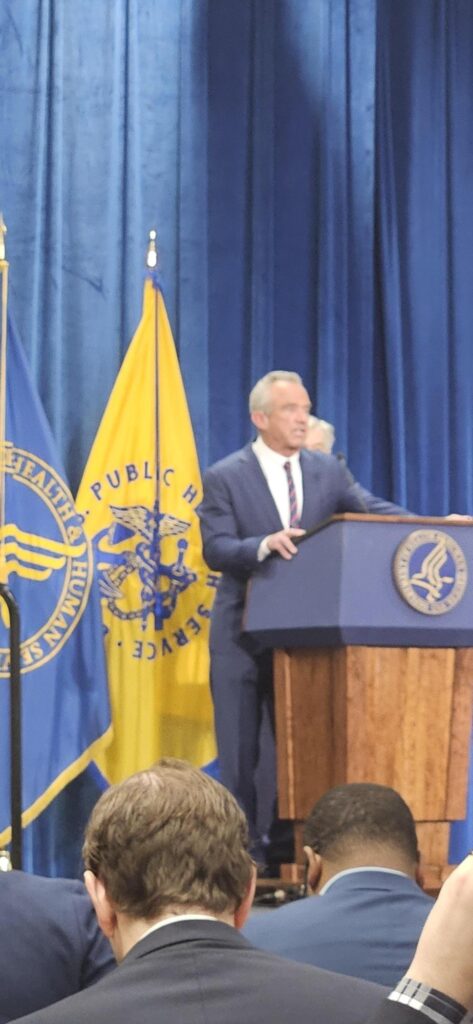
CMS states, “America’s healthcare system is plagued by complexity, high costs, and fragmentation—placing strain on patients, providers, and our national budget.” In order to combat these issues, CMS has created the CMS Digital Health Ecosystem.
The CMS Digital Health Ecosystem is a bold new vision built on collaboration, not just compliance. We are calling on the healthcare industry – data networks, Electronic Health Record (EHR) systems, health app developers, providers, and innovators – to voluntarily align around a shared framework for data and access that empowers people, improves care, and accelerates progress.
While “CMS will do its part: launching key public infrastructure like the National Provider Directory”, they are calling on the private sector to deliver innovation. The categories for the pledge are:
- Data Networks
- Electronic Health Records (EHRs)
- Health Systems and Providers
- Patient Facing Apps — Conversational AI Assistants
- Patient Facing Apps — Diabetes and Obesity
- Patient Facing Apps — Kill the Clipboard
- Payers
Early adopters for each of these pledge categories can be found here.
If you are interested in joining the pledge, click here.
The Innovators Leading the Charge
The event showcased a hodgepodge of apps, each tackling a different slice of the puzzle. A few that stood out included:
- HealthEx: This app is tackling the fundamental problem of fragmentation. Instead of forcing the patient to know where their data is, HealthEx performs a patient lookup to find data locations automatically. It then groups and joins that data over time from all possible care settings, presenting the patient with a truly unified record.
- Nuna: A standout example of “food as medicine.” This app analyzes a patient’s clinical data to provide tailored food selections and recipes that address their specific health issues. It bridges the gap between a doctor’s chart and a patient’s kitchen.
- SyncHealth: focused on infrastructure, this tool converts legacy HL7 v2 messages directly to FHIR, helping modernize the data flow.
- Blue Button 2.0 Implementations: We saw medication apps utilizing Blue Button 2.0 to generate a list of all prior meds (with warnings) in just 2 to 5 minutes. The ability to share this via a simple QR code is a game-changer for emergency access.
The Messy Reality
Despite the innovation, the event highlighted significant hurdles that still need to be cleared:
- App–EHR Alignment Gaps: Connections between apps and EHRs are improving, but not evenly. Smaller or specialty EHRs often face constraints such as limited engineering resources and costly maintenance. At the same time, many apps could do more to clearly articulate their value, streamline onboarding, and better understand what information EHRs are actually required to exchange under g(10). Misalignment in expectations and certification requirements creates friction on both sides.
- Structural Incentive Issues: The current ecosystem doesn’t always motivate smaller EHRs to prioritize app onboarding. There’s room for policy shifts from CMS that make participation more rewarding and less burdensome.
- The Education Gap: Like many of our own clients, the industry is struggling with patient education. The tools exist, but patients largely don’t know what they can do with them.
National Provider Directory
The current National Provider Directory initiative is still early in its development, and much of the discussion right now centers on what information should actually be included in the directory such as provider demographics, practice locations, specialties, and FHIR endpoints. A key question for the industry is determining who will ultimately be responsible for ensuring the directory remains accurate and up to date. Stakeholders often express concern about placing too much administrative burden on providers, but at the same time, accurate directory listings are critical for patient access, referrals, and interoperability.
From our perspective, providers themselves should own the accuracy of their information. EHR vendors can facilitate the process, but they shouldn’t be held responsible for maintaining or validating provider listings. A practical approach may be to establish an annual verification requirement for providers, a standardized process where each provider confirms or updates their directory details. This would strike a balance between minimizing provider burden while ensuring the directory remains timely, reliable, and fit for real world use.
The AI Opportunity: Moving Beyond “Chat”
A major theme of the event was Artificial Intelligence. However, most of what we saw was limited to basic conversational AI, chat and voice answers. For example, we saw Nurseline auto-answer demos where a parent lists symptoms, the AI asks for a temperature, and then recommends urgent care with a pre-generated code for arrival.
AI integration is becoming more common, easier to deploy, and more diverse in how and where it’s used. Chatbots remain simple to implement and immediately useful, but they’re only one piece of the picture.
AI’s ability to process and clean large datasets is emerging as a major value driver. Tools that normalize and structure data at scale open the door for richer analytics, better app experiences, and more consistent clinical insights across workflows. At the other end of the spectrum, we’re starting to see edge-case innovation: AI that interacts with users through audio or even video.
As the old saying goes, with great power comes great responsibility. When AI moves from being controlled to in control, where it makes recommendations and guides users, security, oversight, and guardrails become continuous commitments.
And we see a deeper potential. The next step for AI isn’t just answering FAQs; it’s digesting the entire chart to power proactive, clinically meaningful questions. We envision a future where Gaps-in-Care and quality-focused apps can answer things like:
- “What are the gaps in care for Patient X to meet focus MVP or UDS measures?”
- “Which appointments have vital signs recorded?”
- “How often has this patient been seen without a consultation on weight management?”
- “What specific care is needed to meet Measure 69?”
HL7 AI Challenge
HL7 recently held its first annual HL7 AI challenge, “spotlighting innovators developing AI applications powered by open, standards-based frameworks in healthcare.” The winners were announced and can be found here.
One app that stood out to our team was the Integrated Medical Management and Educational Gateway (IMMEG) Venous Management System (I-VMS). While most AI apps seem to focus on improving administration or delivering information to patients through something like an AI-powered chat, Venous focused on rendering a vectorized atlas of the venous system on chest X-rays to help plan better routes or get early detection of things like malposition.
DHIT’s Commitment
We are proud to have joined the pledge to support this ecosystem. While DHIT does not partner with any specific apps exclusively at this time, we make these connections possible. We have pledged to support apps with robust EHR connections via our Dynamic FHIR API implementations.
The tools are here, we just need to connect them, educate the patients, and push the technology to do more than just chat.
DHIT has already connected with Apple, b.well Connected Health, and Fasten Health. If you’d like to connect your app to our FHIR API, click this link.
Attended the CMS Digital Health Ecosystem event? We’d love to hear your thoughts on the initiative. Are EHRs doing enough to support patient access? Let us know in the comments!