Healthcare interoperability has reached an inflection point. The question is no longer whether FHIR will become the foundation for healthcare data exchange; the question is how organizations will use FHIR to build smarter, more connected, and more automated healthcare workflows.
FHIR DevDays 2026 brought together healthcare innovators, standards developers, implementers, and technology leaders to explore the next phase of interoperability. While the conference covered a wide range of technical topics, one theme emerged consistently:
FHIR is moving beyond data exchange and becoming the foundation for intelligent healthcare applications.
The discussions across SMART on FHIR, analytics, event-driven workflows, quality measurement, artificial intelligence, and payer-provider interoperability demonstrated that the future of healthcare technology will depend on combining standardized clinical data with secure APIs, automation, and intelligent decision support.
Key Takeaways
- FHIR is becoming the foundation for connected, intelligent healthcare applications.
- SMART on FHIR remains essential for secure application integration.
- SQL on FHIR and standardized data views may simplify healthcare analytics.
- Event-driven architectures can enable more responsive clinical workflows.
- AI depends on trusted, structured clinical data.
- Successful interoperability requires continuous testing, collaboration, and refinement.

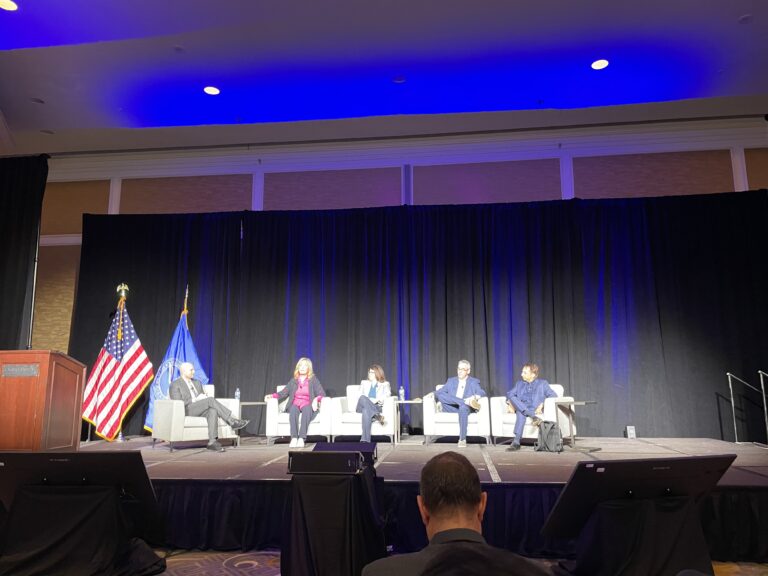
Raychelle Fernandez, VP of DHIT, meets Rachelle Oseni, a Health Scientist at the CDC.
SMART on FHIR Remains the Foundation
Josh Mandel from Microsoft highlighted the continued evolution of SMART on FHIR as the standard approach for secure application integration.
SMART on FHIR provides the framework that allows third-party applications to securely launch within EHR workflows using OAuth 2.0 and OpenID Connect. As healthcare organizations expand their digital ecosystems, SMART enables applications to work across multiple EHR platforms while maintaining secure, standards-based access to patient information.
For healthcare innovators, this reinforces that interoperability is no longer simply about exchanging data. It is about enabling trusted applications to participate seamlessly within clinical workflows.
The continued adoption of SMART patterns also supports broader industry initiatives around patient access, payer-provider interoperability, and ecosystem-based healthcare applications.
Rethinking Healthcare Analytics with SQL on FHIR
One of the most practical sessions was presented by Brendan Kowitz from Microsoft, who demonstrated how SQL on FHIR and ViewDefinitions can simplify healthcare analytics.
FHIR resources are intentionally designed for interoperability, but many reporting systems require relational data models to support analytics, quality measurement, and operational reporting. Traditionally, organizations have invested significant effort in building custom transformation pipelines before analytics can begin.
SQL on FHIR and ViewDefinitions seek to reduce that complexity by providing standardized approaches for projecting FHIR resources into queryable views.
These approaches could help reduce implementation effort while improving consistency across reporting environments.
The broader takeaway is that the healthcare industry is continuing to mature from simply exchanging data toward creating reusable, analytics-ready clinical data ecosystems.
Event-Driven Interoperability Is Becoming Reality
Gino Canessa from Microsoft presented on FHIR Subscriptions, illustrating how healthcare applications are moving away from scheduled polling and toward event-driven architectures.
Historically, many healthcare integrations have relied on batch processes:
- Periodic data extraction
- Scheduled synchronization
- Manual review cycles
FHIR Subscriptions introduce a different model by allowing applications to respond when clinical events occur.
This creates opportunities for workflows such as:
- Automatically identifying care gaps upon receipt of new clinical data.
- Triggering CDS Hooks when patient information changes.
- Initiating Prior Authorization workflows in response to clinical events.
- Updating dashboards as encounters, observations, or medications are added.
As healthcare systems continue adopting modern architectures, event-driven interoperability has the potential to improve responsiveness, reduce unnecessary system traffic, and support more proactive healthcare workflows.
Successful FHIR Implementations Require More Than the Specification
One of the biggest lessons from the FHIR community is that interoperability success is not achieved simply by exposing an API endpoint.
The real-world work happens in the details:
- Resolving implementation guide differences
- Managing profiles and extensions
- Addressing validation issues
- Aligning terminology
- Testing workflows across systems
- Resolving conformance gaps
Healthcare organizations continue learning that interoperability is not a one-time project. It is an ongoing process of collaboration, testing, refinement, and improvement.
FHIR implementation success depends on strong governance, clear requirements, and continuous engagement between healthcare organizations, vendors, standards communities, and implementation teams.
FHIRPath and Clinical Logic Continue to Mature
FHIRPath and Clinical Quality Language (CQL) continue to play an important role in expressing clinical logic, validating resources, and supporting reusable healthcare workflows.
These technologies enable organizations to:
- Evaluate clinical conditions
- Support quality measure calculations
- Validate data structures
- Create consistent business rules
- Improve the portability of clinical logic
As healthcare moves toward more automated decision support and quality measurement, standardized approaches to clinical logic will become increasingly important.
CMS Priorities Continue to Shape Healthcare Innovation
CMS priorities were reflected throughout multiple discussions, particularly around quality measurement modernization, burden reduction, and prior authorization.
Healthcare organizations continue preparing for expanded use of FHIR across initiatives, including:
- Digital quality measurement
- Prior Authorization automation
- Standardized clinical data exchange
- Improved payer-provider interoperability
The CMS Interoperability and Prior Authorization Final Rule (see our blog on HTI-4) has accelerated adoption of FHIR-based workflows, particularly through implementation guides supporting:
- Coverage Requirements Discovery (CRD)
- Documentation Templates and Rules (DTR)
- Prior Authorization Support (PAS)
These standards are moving healthcare beyond manual administrative exchange toward automated, real-time workflows between providers and payers.
For organizations building healthcare technology, FHIR is becoming increasingly important not only for clinical interoperability but also for reducing administrative burden.
Scaling Beyond Individual Patient Exchange with Bulk FHIR
FHIR adoption is also expanding beyond individual patient workflows.
Bulk FHIR enables organizations to exchange larger populations of clinical data securely and efficiently, supporting use cases such as:
- Population health management
- Quality reporting
- Research
- Public health initiatives
- Large-scale analytics
As healthcare organizations increasingly focus on value-based care and measurable outcomes, the ability to analyze standardized clinical data at scale will become critical.
Artificial Intelligence Depends on Interoperability
Artificial intelligence remained an important topic throughout DevDays, but the discussion focused less on standalone AI tools and more on how AI can operate effectively within healthcare workflows.
Across sessions covering documentation, care planning, and workflow automation, one message remained consistent:
Artificial intelligence performs best when built upon standardized, structured clinical data.
FHIR provides that structure.
Standardized resources give AI applications consistent access to patient information while supporting transparency, traceability, and clinical validation.
However, healthcare AI success will not be measured only by speed or automation. It will be measured by:
- Accuracy
- Transparency
- Governance (see our blog on Shifting to Governance)
- Security
- Clinical trust
- Ability to support providers without disrupting workflows
Rather than replacing interoperability, AI depends upon it.
Moving Beyond Point-to-Point Access with SMART Permission Tickets
A forward-looking discussion at FHIR DevDays 2026 focused on SMART Permission Tickets, presented by Brett Marquard during the Argonaut and US Core session.
The goal of Permission Tickets is to create a cross-network approach to data access where applications can present portable, pre-verified permission grants to participating data holders without requiring users to repeatedly complete separate login and authorization steps at every endpoint.
This concept addresses a significant challenge in healthcare interoperability today: enabling secure, scalable access across a growing ecosystem of providers, payers, public health organizations, and healthcare applications.
The current authorization model often requires each application and data holder to establish separate workflows, creating friction for users and increasing implementation complexity. Permission Tickets introduce the possibility of a more portable authorization model where consent and access decisions can travel with the request.
The potential benefits include:
- Reducing repeated authorization experiences for patients and providers
- Simplifying cross-network data access
- Improving interoperability between healthcare applications and data holders
- Supporting scalable access patterns across diverse healthcare ecosystems
The session also highlighted the importance of community-driven standards development, including collaboration through HL7 workgroups and ongoing specification refinement.
For healthcare innovators, Permission Tickets represent another evolution of interoperability: moving beyond simply exchanging data toward managing trusted, secure access to that data across a connected healthcare ecosystem.
Innovation Requires More Than Technology
A recurring theme throughout DevDays was that successful healthcare innovation requires more than adopting the latest technologies.
It depends on:
- Open interoperability standards
- Secure application integration
- Reliable implementation guidance
- Standards-based clinical logic
- Scalable analytics
- Responsible use of artificial intelligence
These foundational capabilities enable healthcare organizations to innovate while maintaining the trust, safety, and compliance required in clinical environments.
Women for FHIR
The Women for FHIR Lunch was an incredible opportunity to connect with some of the emerging leaders in Women for FHIR. The conversation went far beyond a lunch: it created space for meaningful dialogue, new ideas, and shared experiences across generations of HL7 contributors.
The insights shared by newer members of the community provided valuable perspective on what the next generation needs to stay engaged, focused, and supported. Their voices highlighted the importance of recognition, appreciation, mentorship, and continued opportunities to grow within the interoperability community.
Current women leaders were able to listen, learn, and strengthen relationships that will help empower the future of women shaping FHIR and healthcare innovation.

Looking Ahead
FHIR DevDays 2026 demonstrated that healthcare interoperability is entering its next phase.
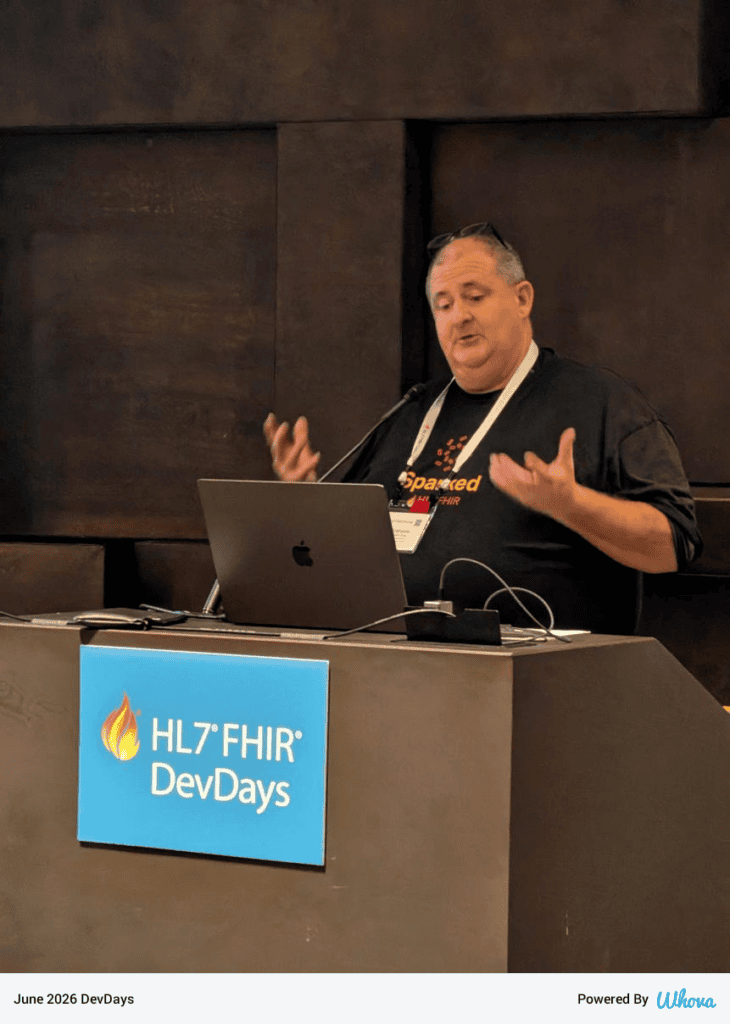
FHIR is not a magic bullet, and I never thought it was. 1% complexity chipped away. Hard work has been done, but the complexity will not go away.
Grahame Grieve
FHIR is no longer simply a mechanism for exchanging data between systems. It is becoming the foundation for:
- Intelligent healthcare applications
- Real-time clinical workflows
- Advanced analytics
- Quality measurement
- AI-assisted decision support
- Automated payer-provider interactions
For healthcare innovators, the opportunity is clear: organizations that invest in standards-based interoperability today will be better positioned to deliver the next generation of connected, intelligent healthcare solutions.
At Dynamic Health IT, these insights reinforce the importance of continued investment in ONC-certified FHIR APIs, SMART on FHIR, CDS Hooks, Bulk FHIR, electronic and digital clinical quality measures, and modern interoperability solutions that help providers, payers, and technology partners improve healthcare delivery.
The future of healthcare interoperability will not be defined only by moving data between systems. It will be defined by what organizations can build on top of that data.
If you’re working through any of this we’d like to hear what you’re running into.
See our previous DevDays blogs:
- FHIR Develepo Days in Amsterdam
- 1st Virtual FHIR DevDays – A Developer’s Perspective
- DevDays FHIR Security & Patient ID
Get new posts by email
We write about CMS and ONC rules, quality measures and interoperability. Choose what you want to hear about.