HRSA released the 2026 Uniform Data System (UDS) Manual on September 8, 2026.
At first glance it looks like a lighter year, but 2026 is a redistribution of burden. HRSA moved reporting away from staffing detail and financial minutiae and toward patient support services, upstream drivers of health, a new quality measure, and accrual accounting. The work moved, and much of it now depends on data your EHR has to capture at the point of care.
The UDS is the annual standardized report that every Section 330 health center, every look-alike, and certain BHW-funded centers must submit through HRSA’s Electronic Handbooks. It covers the full calendar year, January 1 to December 31, regardless of a center’s fiscal year. Any center funded or designated before October 1, 2026 has to report.
Everyone files a Universal Report: 11 tables plus two forms (Health IT Capabilities/Other Data Elements, and Workforce). The tables are:
- Service area and patient profile: ZIP code, Tables 3A, 3B and 4
- Staffing and utilization: Table 5
- Clinical: Tables 6A, 6B and 7
- Financial: Tables 8A, 9D and 9E
When you need to report
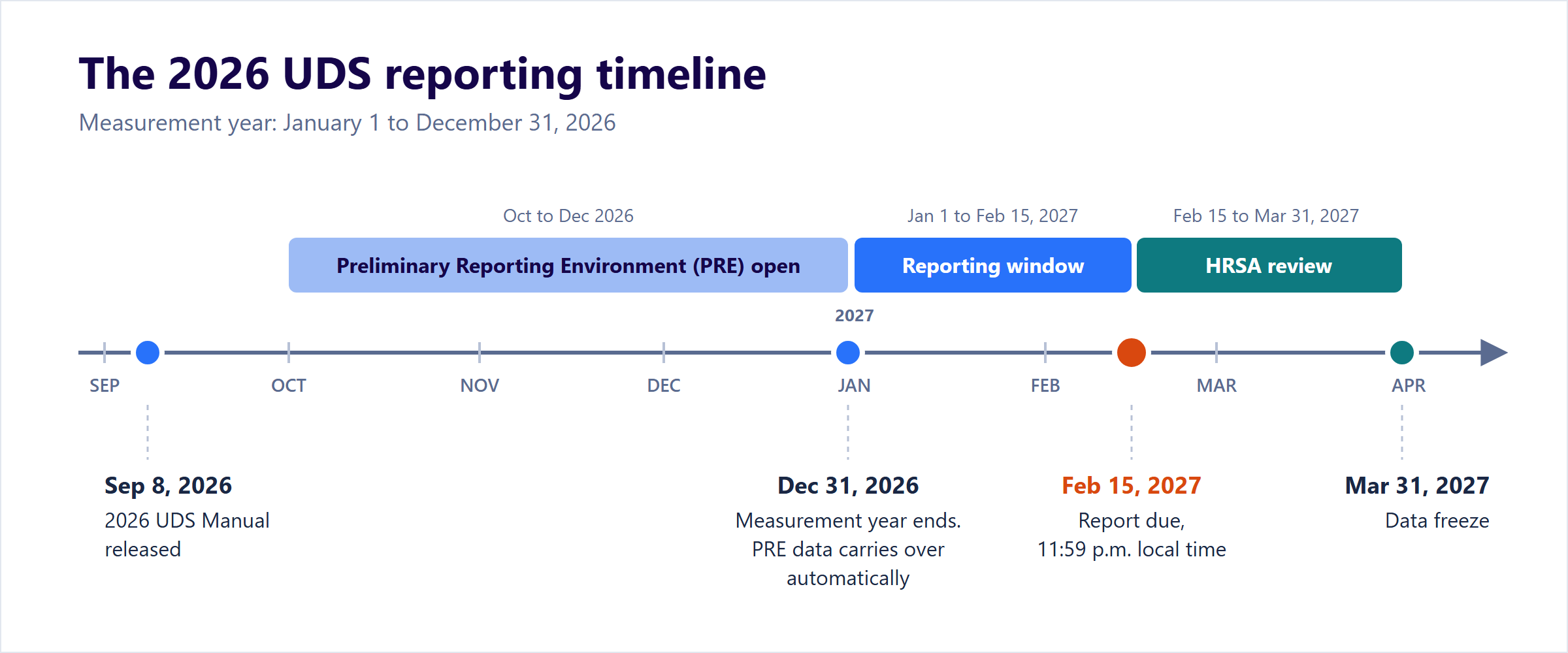
Data you enter in the Preliminary Reporting Environment (PRE) carries over automatically on December 31, so the fall is the time to get the new tables right.
2026 at a glance: what each table needs from you
- ZIP code, Tables 3A and 3B (patients): No changes. Counts still come from countable visits in your EHR.
- Table 4 (patient characteristics): Managed care utilization is no longer reported. Insurance and income still come from registration data.
- Table 5 (staffing and utilization): Enabling Services is now Patient Support Services, and the addendum is no longer reported. Confirm practitioners are mapped to the right service categories.
- Table 6A (diagnoses and services): Eleven lines out, eleven in. Start coding patient support services and upstream drivers of health (Lines 35 to 42) now.
- Tables 6B and 7 (quality and outcomes): Use the 2026 eCQM versions. Watch the new falls measure, the wider breast cancer and HIV age ranges, the two day depression follow up window, and the new sealant measure. Your EHR has to capture falls screening.
- Tables 8A, 9D and 9E (financials): Now fully accrual. Finance maps the general ledger to the new columns; this data comes from your books, not your EHR.
- Appendix C (Health IT form): Answer the new alternative payment model questions. The upstream drivers questions moved to Table 6A.
Fewer fields does not necessarily mean less reporting
The 2026 UDS Manual may look like it significantly reduces reporting requirements. The manual removed or consolidated a number of lines, questions, and reporting elements, but a closer look shows that much of the change is really a shift in how and where the data is reported, rather than a simple reduction in reporting burden.
- Table 6A removes eleven reporting lines but adds eleven new ones, focused on areas such as patient support services and upstream drivers of health. Many of them rely on codes health centers haven’t captured before.
- Table 6B adds another clinical quality measure, Falls: Screening for Future Fall Risk (CMS139v14). Your EHR has to capture fall risk screening in a way the measure can find.
- Tables 9D and 9E move to accrual accounting, and Table 9D is rebuilt around net patient service revenue with a new Column G.
- Upstream drivers of health questions were relocated from Appendix C to coded, patient level lines on Table 6A.
Only a handful of items are truly no longer reported. Most were consolidated into other lines, relocated to another table, or replaced by a new measure or column. Here is where each one went:
| Item | Status | Where it went |
|---|---|---|
| Table 4: managed care utilization (Lines 13a to 13c) | No longer reported | Dropped from Table 4. Nothing replaces it in the UDS. |
| Table 5: Selected Service Detail Addendum (Lines 20a01 to 21h) | No longer reported | The addendum breakout is dropped. The main Table 5 staffing, visit, and patient lines are still reported. |
| Table 5 and 8A: Enabling Services | Consolidated | Renamed Patient Support Services. On Table 8A the subcategories (Lines 11a to 11h) collapse into one line, while Table 6A now counts specific support services (Lines 35 to 38) as coded visits. |
| Table 6A: mammogram (Line 22) and Pap test (Line 23) | Still needed | No longer 6A lines, but the same data drives Breast Cancer Screening and Cervical Cancer Screening on Table 6B. Keep capturing it. |
| Table 6A: sealants (Line 30) | Replaced | Sealant data now feeds the new Sealant Receipt on Permanent First Molars measure on Table 6B, which needs tooth level coding. |
| Table 6A: COVID lines, abnormal breast and cervical findings, dermatitis, oral surgery, rehabilitative dental services | No longer reported | No longer reported on Table 6A. |
| Other Data Elements Form: outreach and enrollment assists | Relocated | Some elements now sit in the Table 6A patient support services and upstream drivers of health section. |
| Table 8A: facility and non clinical support allocation (Column B) | Replaced | Replaced by a split of each cost center into personnel costs (Column A1) and other direct costs (Column A2). |
| Table 8A: quality improvement (Line 12a) and IT (Line 15) | Consolidated | Now reported together on new Line 14a. |
| Table 8A: donations (Line 18) | No longer reported | Donated facilities, services, and supplies are no longer reported anywhere in the UDS. |
| Table 9D: retroactive settlements (Columns C1 to C4) | Relocated | C1, C2, and C4 amounts flow through Collections (Column B) and Adjustments (Column D). C3 moves to new Line 18, Third Party Incentive Revenue. |
| Table 9D: payment form lines (non managed care, capitated, fee for service managed care) | Consolidated | Collapsed into one total line per payer. |
| Table 9D: self pay and sliding fee lines | Consolidated | One Total Self Pay line (Line 13). Sliding fee discounts are reported as adjustments. |
| Table 9D: bad debt write off (Column F) | Relocated | Reported on Line 15, Column G, as an offset to net patient service revenue. |
| Table 9E: Health Center Program grant lines (1a to 1e, 1o to 1q) | Consolidated | Combined into a single Line 1. |
| Table 9E: Ryan White Part C (Line 2) and Promoting Interoperability (Line 3a) | Relocated | Reported on Line 5, Total Other Federal Grants. |
| Appendix C: upstream drivers of health screening questions | Relocated | Now coded, patient level lines on Table 6A (Lines 39 to 42). |
| Appendix C: several EHR implementation questions | No longer reported | No longer asked. |
The good news: most of what 2026 asks for is data your systems already hold or can start capturing now. The hard part is keeping measure versions, code sets, and table layouts current. That is exactly what a centralized UDS Platform takes off your team’s plate.
What changed for 2026, table by table
The tables below follow the order of the manual.
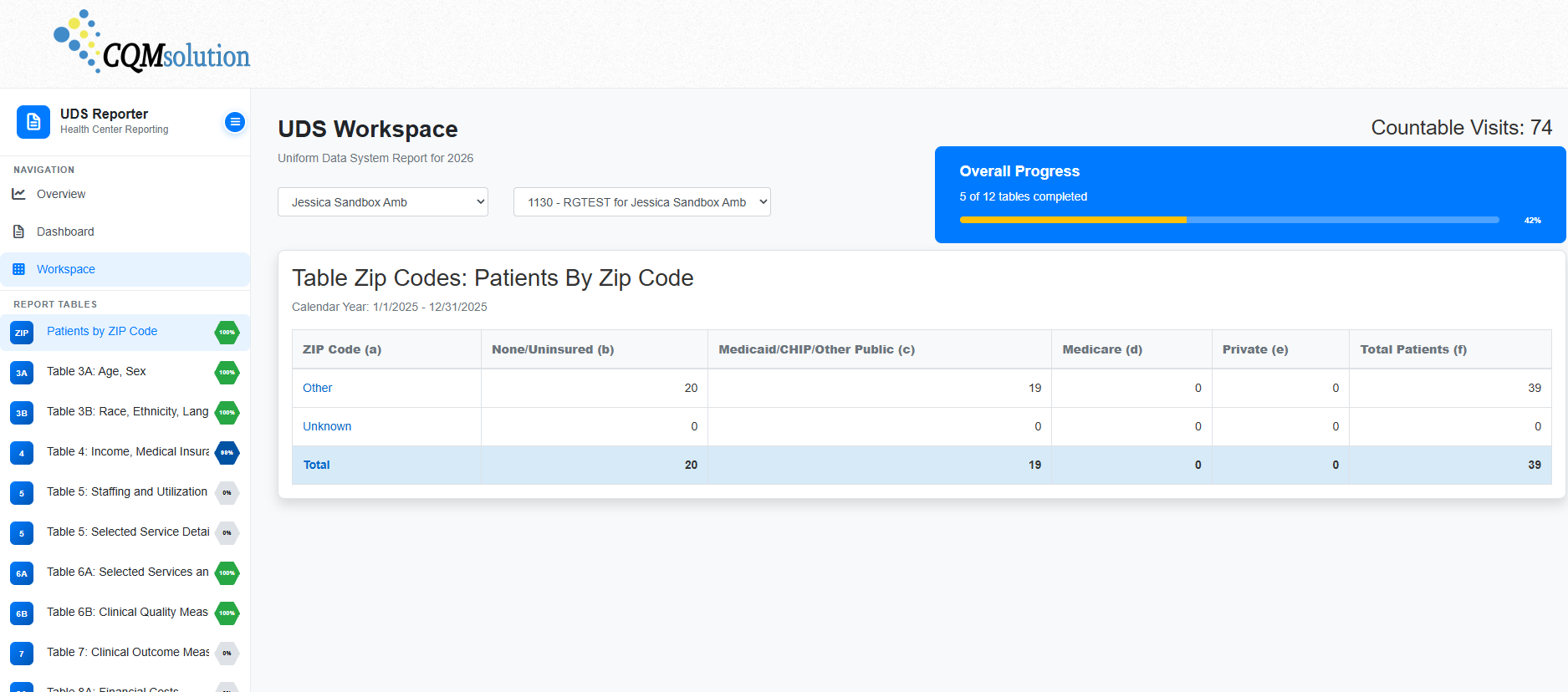
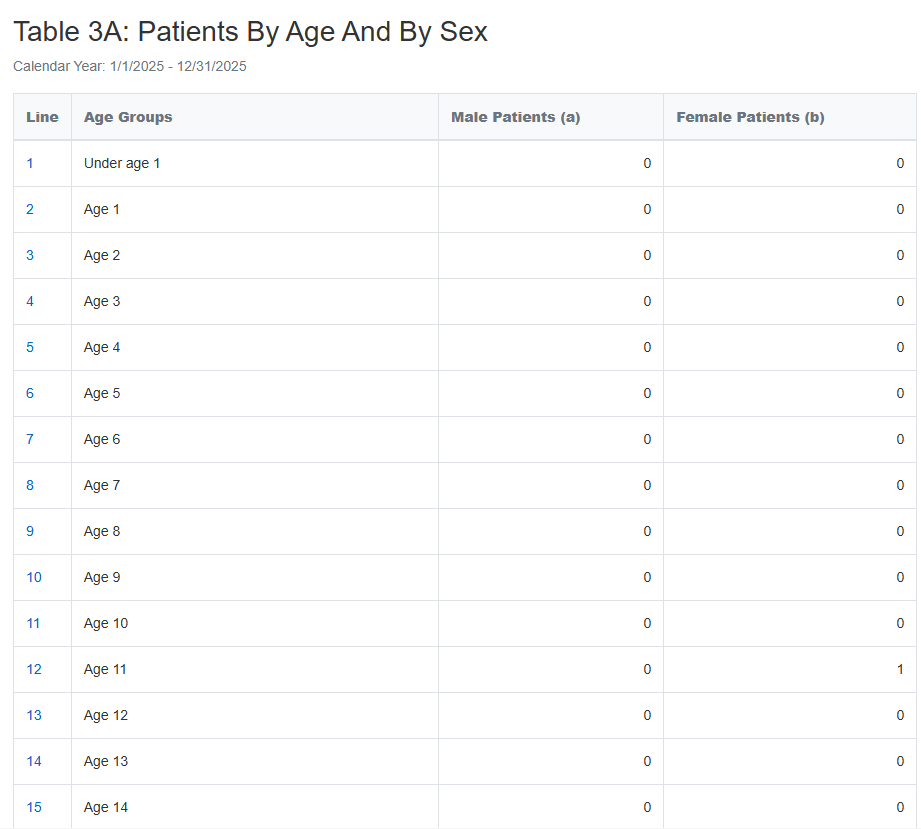
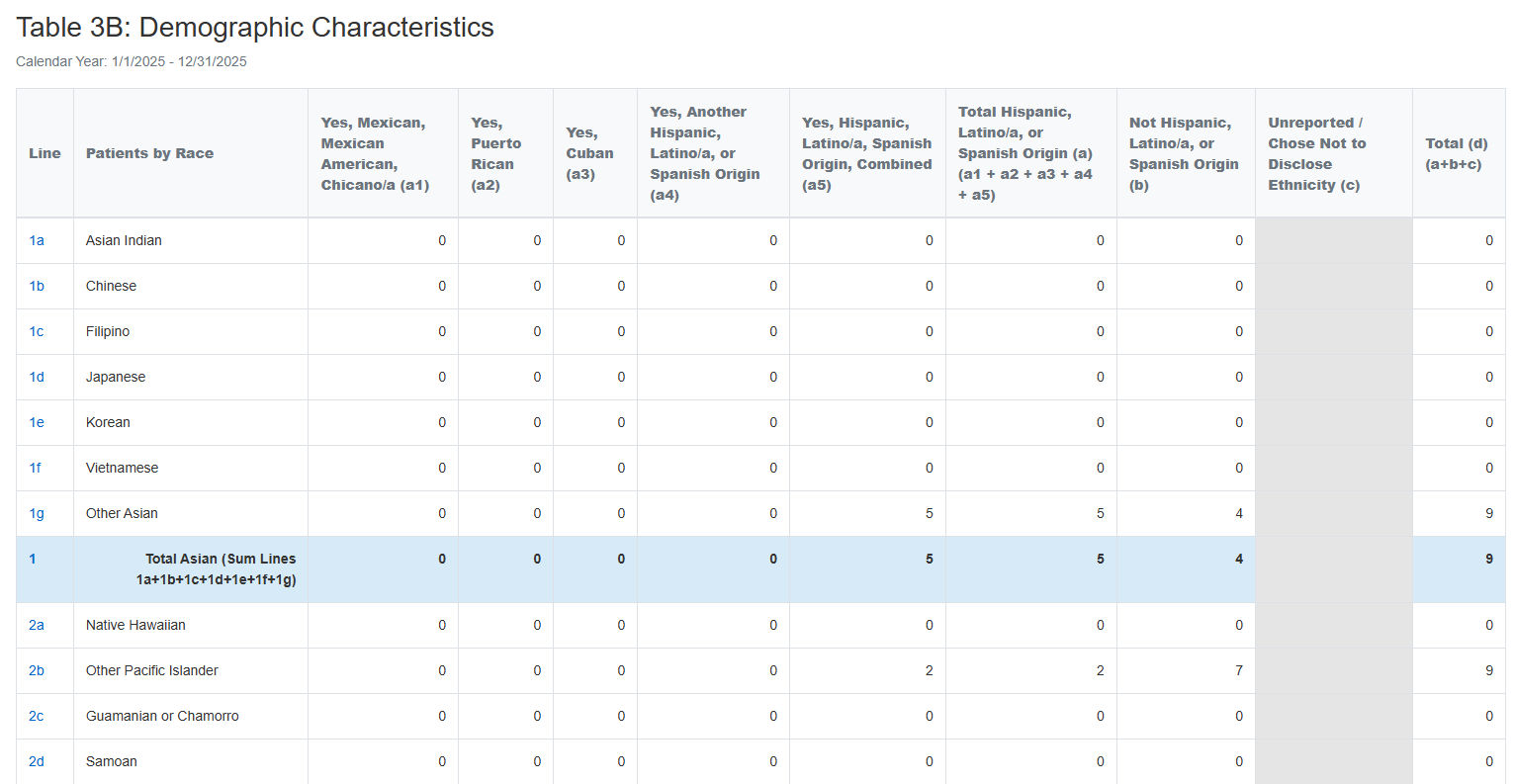
Patients by ZIP Code, Tables 3A and 3B: no key changes
The ZIP code table and Tables 3A and 3B are unchanged. Race and ethnicity reporting stays on the federal standard that was in place before 2025 for now. HHS agencies have until September 2029 to comply with the revised standard.
Because these tables carry over as is, they look the same in the UDS Platform this year as they did last year.
Tables 4 and 5
- Table 4 no longer reports managed care utilization (Lines 13a to 13c).
- In Table 5, Enabling Services is renamed Patient Support Services. The Selected Service Detail Addendum (Lines 20a01 to 21h) is no longer reported, but the main staffing, visit, and patient lines are unchanged.
- Also in Table 5, Total Facility and Non-Clinical Support Personnel (Line 33) is renamed Total Facility and Support Services Personnel.
Table 6A: eleven lines out, eleven lines in
Eleven lines are no longer reported on Table 6A, including the COVID respiratory and COVID test lines, mammogram, Pap test, sealants and oral surgery. Mammograms and Pap tests still drive the breast and cervical cancer screening measures on Table 6B, and sealants now feed the new sealant measure. Eleven new lines take their place on 6A, most of them for patient support services and upstream drivers of health:
The 11 new Table 6A lines for 2026
| New line | Reporting element | What it captures |
|---|---|---|
| 9a | Diabetes mellitus type 1 | Type 1 diabetes, also counted within Line 9. |
| 20g | Intellectual and developmental disabilities | New diagnosis line under mental health conditions. |
| 26g | Autism spectrum disorder screening | Screening, reported separately from diagnosis. |
| 35 | Case management | Direct provision only. A referral on its own does not count. |
| 36 | Eligibility assistance | Coded with SNOMED CT rather than CPT or ICD. |
| 37 | Transportation | Transportation services provided directly to the patient. |
| 38 | Language assistance services | Interpretation and translation delivered to the patient. |
| 39 | Upstream drivers of health screening | Requires a standardized screener, not a note in the chart. |
| 40 | Food insecurity | Services provided to address it, which is separate from screening for it. |
| 41 | Housing instability | Services provided to address it. |
| 42 | Financial insecurity | Services provided to address it. |
Most health centers deliver case management, eligibility assistance, transportation, and language assistance every day. Those services now have to be coded in a way a UDS report can find.
Some codes were also updated. HRSA publishes a separate Table 6A Code Changes file with the details, which can be found here: https://bphc.hrsa.gov/sites/default/files/bphc/compliance/2026-uds-table-6a-code-changes.pdf
Line 26, previously health supervision of infant or child (ages 0 through 11), is renamed well child visit (ages 0 through 11).
Table 6B: quality measures
Measures are aligned to the 2026 CMS eCQM versions named in the manual; centers should not use later versions. Specific changes:
| Measure | 2026 spec | What changed |
|---|---|---|
| Childhood Immunization Status | CMS117v14 | Reporting is voluntary this year. |
| Breast Cancer Screening | CMS125v14 | Age range widens to 42 to 74. It was 52 to 74. |
| HIV Screening | CMS349v8 | Denominator now covers ages 15 to 65. |
| Depression Screening and Follow Up | CMS2v15 | Numerator now accepts a follow up plan documented up to 2 days after the visit, or an active depression medication. |
| Sealant Receipt on Permanent First Molars | SFM-CH-A | Replaces the old dental sealant measure. Two rates for sealants on permanent first molars. |
| Falls: Screening for Future Fall Risk | CMS139v14 | New measure. Fall risk screening in patients 65 and older. |
The new falls measure deserves a closer look. CMS139v14 counts patients 65 and older who were screened for future fall risk during 2026. Because it is an eCQM, the screening has to be recorded as structured data your EHR can report. Check now that your EHR captures it, while many of those patients still have a visit left this year.
Table 7: health outcomes
The measures are updated to the 2026 eCQM specifications.
Table 8A: costs
The facility and non clinical support allocation column (Column B) is no longer reported. In its place, each cost center is split into personnel costs (A1) and other direct costs (A2), with Column A as their sum. Several lines also moved or were consolidated:
- Enabling services is renamed Patient Support Services, and its subcategories (Lines 11a to 11h) are consolidated into that single line.
- Quality improvement and IT costs now share a new Line 14a.
- Donations are no longer reported anywhere in the UDS.
- Non-Clinical Support (Line 15) is renamed Other Support Costs.
Tables 9D and 9E: same revenue, new structure
Both tables now follow GAAP accrual accounting and should tie to the center’s financial statements or audit. Previously, Table 9E was reported on a cash receipt basis. This is the largest structural change in the manual.
Table 9D (patient service revenue):
- The retroactive settlement columns (C1 through C4) are no longer separate. Those amounts now flow through Collections (Column B) and Adjustments (Column D), and the former C3 amounts move to the new Third Party Incentive Revenue line (Line 18).
- The managed care and fee for service breakouts are collapsed into one line per payer.
- Self pay revenue, including sliding fee, is collapsed into a single Total Self Pay line (Line 13).
- Sliding fee discounts for self pay patients are now reported as adjustments.
- The bad debt column is relocated to Line 15, Column G, where it offsets net patient service revenue.
- New additions: a net patient service revenue column (Column G), plus new lines for pharmacy revenue and third party incentive revenue.
Table 9E (other revenue):
- Health Center Program (BPHC) grant lines are consolidated into a single line (Line 1).
- The separate Ryan White Part C and Promoting Interoperability lines are consolidated into Line 5, Total Other Federal Grants.
- State and local indigent care programs (Line 6a) now include only programs that do not reimburse on a service specific basis.
Appendix C: the Health IT form
| Area | What changed |
|---|---|
| EHR implementation | Several questions were removed. |
| Upstream drivers screening | Relocated. These questions are now coded, patient level lines on Table 6A (Lines 39 to 42). |
| MOUD, telehealth, family planning | Moved here from the old Other Data Elements Form. |
| Value based purchasing | Three new questions: which payers, which model types, and what share of revenue is tied to value based contracts. |
| Services for patients under 19 | New question on whether the center provides puberty blockers, sex hormones or related surgery. |
The Workforce form (Appendix D) has no key changes.
What to do with the weeks you have left
- Stand up capture for Table 6A Lines 35 through 42 now. Case management, eligibility assistance, transportation, language assistance, and the four upstream drivers lines. Confirm the codes exist in your system, confirm staff are applying them, and confirm your UDS extract can reach them.
- Run the falls screening measure against your 65 and older panel. Find who is eligible, who has been screened, and who still has a visit scheduled this year. Confirm your EHR records the screening as structured data.
- Pull the new breast cancer screening denominator. Everyone aged 42 to 51 who just entered the measure.
- Change the depression follow up workflow, not the report. If a positive screen does not produce a documented plan within two days, the visit is already lost.
- Audit dental tooth level coding for children born in 2016. Missing or invalid tooth numbers cannot be counted.
- Start the accrual mapping with finance. Table 8A personnel and other cost split, Table 9D net patient service revenue, pharmacy and incentive revenue lines, Table 9E consolidation. Reconcile against the audit before the Preliminary Reporting Environment closes.
- Confirm your eCQM engine is on the 2026 specifications, not a later version. CMS has published newer versions of several of these measures. Those are not valid for 2026 UDS.
- Decide on childhood immunization status.
Make 2026 reporting the easy part
Dynamic Health IT supports health center UDS reporting through our centralized UDS Platform. CQMsolution calculates clinical quality measures against the specification for the reporting year, then carries those results into UDS reporting rather than treating the two as separate systems.
The real reporting burden is caused by the number of disconnected steps between clinical documentation and a completed report: exporting data, recalculating measure populations, reconciling spreadsheets, and reentering results. In a year that redistributes burden, every one of those handoffs costs more. A connected workflow, from eCQM calculation through UDS reporting removes them.
When a measure version changes, or a denominator moves from 52 to 42, or a new measure appears in September for a year that started in January, the question is whether your calculation is running the right specification. With the UDS Platform, your team spends the fall closing gaps instead of rebuilding reports.
Reporting technology should not create more work. It should help health centers spend less time moving data and more time using it. If you are working through the 2026 changes and want to see how the UDS Platform handles them, contact us.