On July 16, CMS published the CY 2027 Medicare Physician Fee Schedule proposed rule (CMS-1848-P) in the Federal Register. All 716 pages of it! Buried in the payment updates and drug pricing provisions are the Quality Payment Program proposals, and we will break them down in this blog.
CMS describes the changes as “a limited number of significant policy changes.” There aren’t many of them, but the ones that are here reshape the program: traditional MIPS finally gets a sunset date, FHIR-based quality reporting gets a proposed timeline, and Shared Savings Program ACOs get a new way to report eCQMs.
Comments are due September 14, 2026.
Traditional MIPS is ending after 2028
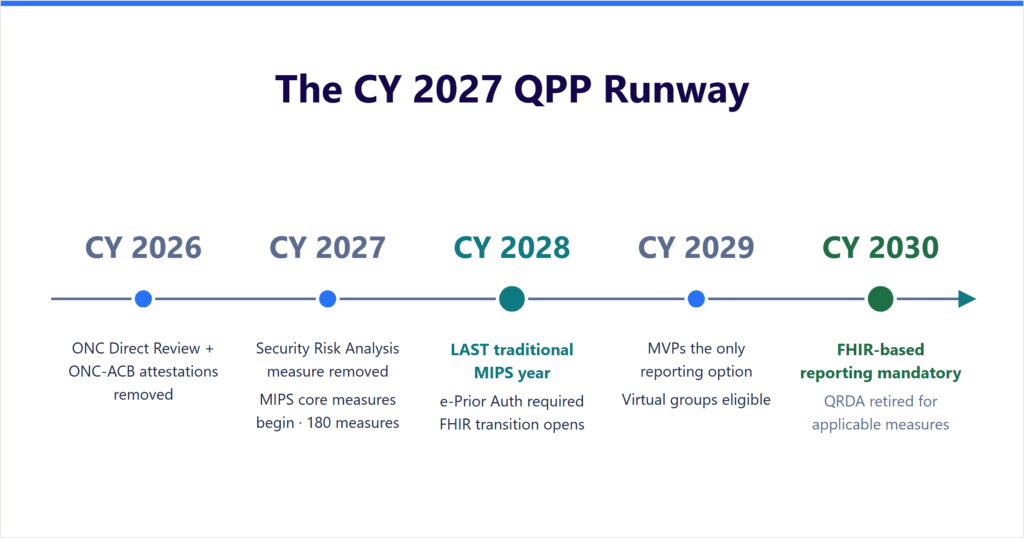
CMS has been signaling since 2019 that MIPS Value Pathways (MVPs) would eventually replace traditional MIPS. The signaling has evolved into a final date: the rule proposes to sunset traditional MIPS after the CY 2028 performance period (the 2030 payment year).
Beginning with the CY 2029 performance period, MVPs would be the only MIPS reporting option for clinicians who don’t participate in a MIPS APM. Clinicians in a MIPS APM would keep the APM Performance Pathway (APP).
If your organization, or your clients, are still reporting traditional MIPS, the clock now has a face on it: three more performance periods (2026, 2027, 2028), then you must report MVPs. CMS frames the long runway as time to pick the right MVP, build the workflows, and stand up subgroup-level data collection where needed. Don’t spend all three years picking.
To support the transition, the MVP portfolio keeps growing:
- 3 new MVPs proposed for 2027 — Diabetic Disease, Hypertension, and Hospitalist — bringing the total to 30
- All 27 existing MVPs get modified, including core measure selections for each
- Virtual groups would be able to report MVPs starting in CY 2029
CMS is also asking (via RFI) whether MVP scores should be normalized within each MVP (comparing a cardiologist against other cardiologists rather than against dermatologists) before payment adjustments are calculated. That’s a fundamental scoring change, and CMS wants feedback on whether it should land with full MVP implementation in 2029 or get piloted earlier.
The MIPS quality category gets a new twist: core measures
The rule proposes to retire two familiar fixtures of the quality category:
- The high priority measure designation — gone entirely, including as a measure retention criterion
- The requirement to report at least one outcome measure (or high priority measure) — gone too
In their place is a new MIPS core measure designation. Clinicians would be required to report one core measure as 1 of 6 quality measures in traditional MIPS, or 1 of 4 in an MVP. No applicable core measure? You’d attest to that and substitute another measure. Small practices are exempt from the requirement, and from the attestation.
The designation lands on roughly 73 measures spread across the 30 MVPs, and each MVP has its list of two to six core measures. A clinician picks one. The Value in Primary Care MVP, for example, offers Q001, Q134, and Q236; the Hospitalist MVP offers Q005, Q008, and Q047.
The measure inventory itself shrinks to a proposed 180 quality measures for 2027.
177 available in traditional MIPS, plus 3 that can only be used in MVPs:
- 10 measures added for 2027, plus one more for 2028 — 5 PROMIS-based functional improvement measures replacing the 7 FOTO measures below, 4 current QCDR measures adopted as MIPS CQMs, and 2 prevention and chronic disease measures (a new LDL-C control measure, plus a breast cancer screening follow-up eCQM held back to 2028)
- 20 measures removed — including seven FOTO functional status measures (Q217–Q222 and Q478) that the five new functional measures replace, plus long-standing entries like CAD antiplatelet therapy (Q006) and atrial fibrillation anticoagulation (Q326)
- Substantive changes to 43 more
The full proposed addition list, with stewards and core-measure status:
| Measure | Measure Steward | Measure Type | Core Measure | Collection Type |
|---|---|---|---|---|
| Low Density Lipoprotein Cholesterol (LDL-C) Monitoring and Management | American Heart Association | Intermediate Outcome | Yes | MIPS CQM |
| Functional Improvement for Patients with Neck Impairments | Limber Health, Inc. and Patient360, LLC | PRO-PM | No | MIPS CQM |
| Functional Improvement for Patients with Upper Extremity Impairments | Limber Health, Inc. and Patient360, LLC | PRO-PM | No | MIPS CQM |
| Functional Improvement for Patients with Back Impairments | Limber Health, Inc. and Patient360, LLC | PRO-PM | Yes | MIPS CQM |
| Functional Improvement for Patients with Lower Extremity Impairments | Limber Health, Inc. and Patient360, LLC | PRO-PM | No | MIPS CQM |
| Functional Improvement for Patients with Knee Impairments | Limber Health, Inc. and Patient360, LLC | PRO-PM | No | MIPS CQM |
| Age-Related Hearing Loss: Comprehensive Audiometric Evaluation | American Academy of Otolaryngology – Head and Neck Surgery Foundation | Process | Yes | MIPS CQM |
| Patient-Reported Experience with Anesthesia | American Society of Anesthesiologists Anesthesia Quality Institute | PRO-PM | No | MIPS CQM |
| Intraoperative Hypotension (IOH) Among Non-Emergent Noncardiac Surgical Cases | Anesthesia Quality Registry (AQR QCDR) with AQI and ASA | Intermediate Outcome | Yes | MIPS CQM |
| SGLT2 Inhibitors for Patients with Chronic Kidney Disease (CKD) With or Without Type 2 Diabetes Mellitus | A Value-Based Care Registry | Process | No | MIPS CQM |
| Rate of Timely Follow-up on Abnormal Screening Mammograms for Breast Cancer Detection CY 2028 | Brigham and Women's Hospital | Process | No | eCQM |
Five of the ten new measures are PROMIS-based patient-reported outcome measures for neck, upper extremity, back, lower extremity, and knee impairments, and they will replace the seven proprietary FOTO measures below. CMS’s stated rationale is that the FOTO measures lock clinicians into a single proprietary instrument, while the replacements accept PROMIS, the Neck Disability Index, QuickDASH, LEFS, and equivalent tools.
The 20 proposed removals:
| Quality # | Measure | Measure Steward | Reason for Removal |
|---|---|---|---|
| Q006 | Coronary Artery Disease (CAD): Antiplatelet Therapy | American Heart Association | No longer maintained by steward |
| Q007 | Coronary Artery Disease (CAD): Beta-Blocker Therapy – Prior MI or LVEF ≤ 40% | American Heart Association | No longer maintained by steward |
| Q143 | Oncology: Medical and Radiation – Pain Intensity Quantified | American Society of Clinical Oncology | End of topped-out lifecycle |
| Q217 | Functional Status Change for Patients with Knee Impairments | Focus on Therapeutic Outcomes, Inc. | Duplicative of new measure |
| Q218 | Functional Status Change for Patients with Hip Impairments | Focus on Therapeutic Outcomes, Inc. | Duplicative of new measure |
| Q219 | Functional Status Change for Patients with Lower Leg, Foot or Ankle Impairments | Focus on Therapeutic Outcomes, Inc. | Duplicative of new measure |
| Q220 | Functional Status Change for Patients with Low Back Impairments | Focus on Therapeutic Outcomes, Inc. | Duplicative of new measure |
| Q221 | Functional Status Change for Patients with Shoulder Impairments | Focus on Therapeutic Outcomes, Inc. | Duplicative of new measure |
| Q222 | Functional Status Change for Patients with Elbow, Wrist or Hand Impairments | Focus on Therapeutic Outcomes, Inc. | Duplicative of new measure |
| Q320 | Appropriate Follow-Up Interval for Normal Colonoscopy in Average Risk Patients | American Gastroenterological Association | End of topped-out lifecycle |
| Q326 | Atrial Fibrillation and Atrial Flutter: Chronic Anticoagulation Therapy | American Heart Association | No longer maintained by steward |
| Q332 | Adult Sinusitis: Appropriate Choice of Antibiotic (Appropriate Use) | American Academy of Otolaryngology – Head and Neck Surgery Foundation | Duplicative of Q331 |
| Q350 | Total Knee or Hip Replacement: Shared Decision-Making – Trial of Conservative Therapy | American Association of Hip and Knee Surgeons | Low bar process measure |
| Q378 | Children Who Have Dental Decay or Cavities | Centers for Medicare & Medicaid Services | Lacks robustness |
| Q384 | Adult Primary Rhegmatogenous Retinal Detachment Surgery: No Return to OR Within 90 Days | American Academy of Ophthalmology | End of topped-out lifecycle |
| Q415 | Emergency Department Utilization of CT for Minor Blunt Head Trauma, Age 18+ | American College of Emergency Physicians | End of topped-out lifecycle |
| Q430 | Prevention of Post-Operative Nausea and Vomiting (PONV) – Combination Therapy | American Society of Anesthesiologists | Extremely topped out (99.34%) |
| Q463 | Prevention of Post-Operative Vomiting (POV) – Combination Therapy (Pediatrics) | American Society of Anesthesiologists | Extremely topped out (98.99%) |
| Q478 | Functional Status Change for Patients with Neck Impairments | Focus on Therapeutic Outcomes, Inc. | Duplicative of new measure |
| Q483 | Person-Centered Primary Care Measure (PCPCM PRO-PM) | The American Board of Family Medicine | Limited adoption, no benchmark |
19 of the proposed core measures are currently topped out and capped at 7 points for the CY 2026 performance period. Under the proposal, topped-out core measures would escape that cap and instead score against defined topped-out benchmarks, where a high performance rate is once again worth the full 10 points.
One thing that isn’t in this rule: any proposal to move the performance threshold.
Promoting Interoperability: less attestation, more prior authorization
The Promoting Interoperability category sheds some weight:
- The ONC Direct Review attestation (required) and ONC-ACB Surveillance attestation (optional) would be removed starting with the CY 2026 performance period
- The Security Risk Analysis measure would be removed starting with CY 2027 (HIPAA still requires one)
The Electronic Prior Authorization measure would become an optional/bonus measure for 2027, then required starting in CY 2028. Clinicians would need to complete at least one prior authorization request using FHIR-enabled, ONC-certified health IT modules. A companion measure, Electronic Prior Authorization for Prescription Drugs, is also proposed, aligning with the pending Interoperability Standards and Prior Authorization for Drugs proposed rule (CMS-0062-P).
If you read our post on CMS’s digital health ecosystem push, this is that agenda showing up in the payment rules.
The CEHRT definition catches up with HTI-5
Remember the HTI-5 reset, where ONC proposed decertifying half the certification criteria inventory? CMS is now proposing to update the definition of CEHRT at 42 CFR 414.1305 to match. The following criteria would come out of the CEHRT definition:
| Criterion | Section | What It Covers |
|---|---|---|
| Family Health History | § 170.315(a)(12) | Recording a patient’s family health history |
| Patient Health Information Capture | § 170.315(e)(3) | Letting patients contribute their own health data |
| Automated Numerator Recording | § 170.315(g)(1) | Automatically counting the patients who meet a measure |
| Automated Measure Calculation | § 170.315(g)(2) | Automatically calculating quality measure results |
| Clinical Quality Measures — Filter | § 170.315(c)(4) | Breaking quality measure results out by race, ethnicity, sex, age, and payer |
The (c)(4) CQM filter criterion and the (g)(1)/(g)(2) measure calculation criteria would no longer be required for CEHRT.
The FHIR timeline: 2028 transition, 2030 mandate
To us, the most consequential pages in the QPP section are an RFI, not a proposal. CMS is seeking comment on the transition to FHIR-based digital quality measure reporting, structured as:
- A 2-year transition period beginning with the CY 2028 performance period, keeping existing reporting options while supporting FHIR-based reporting for selected measures
- Mandatory FHIR-based reporting for applicable measures beginning with the CY 2030 performance period, at which point prior electronic reporting approaches would no longer be available for those measures
This would be the first time CMS has put concrete years on the QPP side of the dQM transition. If FHIR-based reporting isn’t on your product roadmap yet, this is the rule that should put it there.
ACO Measure Types
Shared Savings Program ACOs reporting the APP Plus measure set get three notable proposals:
- The MIPS CQMs survives. It was scheduled to disappear after 2026; CMS proposes extending it for CY 2027 and beyond.
- A new measure type: Medicare eCQMs. These follow eCQM specifications but are calculated on the beneficiaries assigned to the ACO rather than all patients across all payers. ACOs reporting Medicare eCQMs wouldn’t be eligible for the Complex Organization Adjustment or the eCQM/MIPS CQM reporting incentive.
- Flat benchmarks for good. All Medicare CQMs (and the new Medicare eCQMs) would be scored on flat benchmarks going forward, with retroactive flat-benchmark scoring for three measures (Q001, Q134, Q236) in 2026.
Four measure types now sit side by side, and they don’t behave the same way:
| Collection Type | Population | Benchmarks | Complex Org. Adj. | Reporting Incentive |
|---|---|---|---|---|
| eCQM | All patients, all payers | Standard MIPS historical benchmarks | Yes | Yes |
| MIPS CQM | All patients, all payers | Standard MIPS historical benchmarks | No | Yes |
| Medicare CQM | Beneficiaries with at least one primary care service from an ACO professional | Flat benchmarks, PY 2026 forward | No | No |
| Medicare eCQM * | Beneficiaries assigned to the ACO (Sec. 425.20, subpart E) | Flat benchmarks, PY 2027 forward | No | No |
Note the population difference in rows three and four: Medicare CQMs cover beneficiaries who received at least one primary care service from an ACO professional, while Medicare eCQMs cover beneficiaries assigned to the ACO.
The APP Plus set itself would slim from 10 measures to 8, dropping Substance Use Disorder Treatment (Q305) and Adult Immunization Status (Q493) beginning in PY 2027.
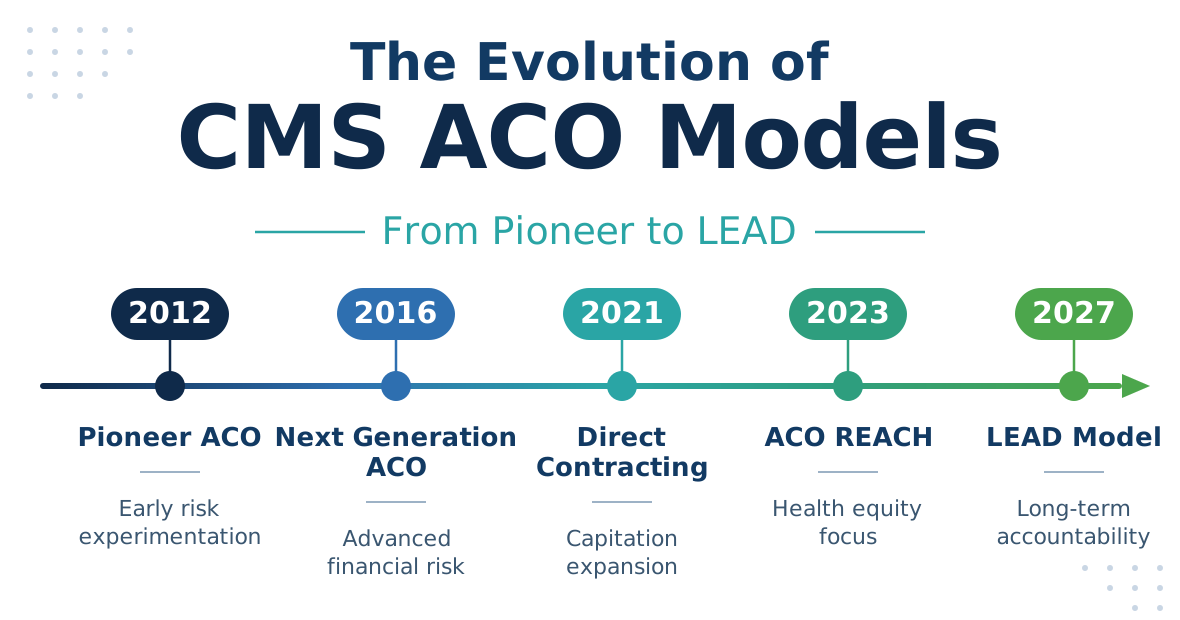
On the Advanced APM side, Qualifying APM Participant (QP) determinations would move from the NPI level to the TIN/NPI level. A clinician’s MIPS exemption and incentive would only follow the TINs actually participating in the Advanced APM and the QP thresholds get updated per the Consolidated Appropriations Act, 2026. (For the longer arc of where ACO policy is headed, see our history of CMS ACO models.)
MSSP and ACO policy changes:
The largest block of proposals in this rule is a Medicare Shared Savings Program (MSSP) overhaul that CMS projects will reduce Trust Fund spending by $5.5 billion through 2036. The goal is to reward the ACOs that take on genuine risk and bring new patients into value-based care, and trim the benchmark advantages that let established ACOs coast.
Bigger rewards for taking on risk
Three of the headline financial changes are simple rate moves:
| Provision | Current | Proposed |
|---|---|---|
| BASIC track Level E sharing rate | 50% | 60% |
| ENHANCED track regional adjustment — maximum weight (lower-spending ACOs) | 50% | 35% |
| Prior savings adjustment scaling factor | 50% | 75% |
Raising the BASIC track’s top level (Level E) from a 50% to a 60% shared-savings rate narrows the gap with the ENHANCED track and makes two-sided risk more attractive for ACOs not yet ready for the ENHANCED track’s 75%. At the same time, CMS proposes to reduce the regional adjustment for lower-spending ENHANCED-track ACOs (the maximum weight drops from 50% to 35%) — reining in a benchmark boost that had grown large enough to outweigh actual savings. And the prior savings adjustment scaling factor rises from 50% to 75%, so ACOs that have already generated savings keep more of that credit in their next benchmark.
A benchmark that pulls in new participants
CMS proposes a new growth adjustment to the historical benchmark for ACOs that add beneficiaries new to value-based care, a direct incentive to expand the program rather than reshuffle existing lives. It’s paired with a proposal to risk-adjust the existing 5% cap on upward benchmark adjustments, so an ACO caring for a sicker-than-average population isn’t penalized by a flat ceiling. Together these tilt the benchmark toward ACOs that grow and toward those managing genuinely complex patients.
ACPT, assignment, and a new primary-care payment lever
- ACPT reform. The Accountable Care Prospective Trend would move to performance-year-specific modified USPCC growth rates, so every ACO reconciled in the same year is trended on the same basis. CMS also proposes a permanent guardrail capping how far the projection can deviate from actual growth which would be no more than 1.0 percentage point below or 1.5 percentage points above. They would apply that relief retroactively to address the benchmark harm ACOs saw across 2024–2026.
- Beneficiary assignment changes. CMS would revise who counts toward an ACO’s assigned population. A beneficiary with even one month of combined Part A and Part B coverage (and no Medicare Advantage enrollment that month) would become assignable, an estimated 248,000 additional assigned beneficiaries. CMS would also exclude primary care billed through non-ACO TINs and update the definition of primary care services used in assignment.
- A new way to pay for longitudinal primary care. The G2211 visit-complexity add-on code would become a modifier (MOD1), and a second modifier, MOD2, would be exclusively available to ACO participants (and LEAD Model providers), MOD1 pays about 16% on top of the base E/M code; MOD2 pays 32% and applies to all of an ACO clinician’s patients, assigned or not.
- Data-completeness relief for multi-EHR ACOs. An ACO would only need to submit quality data for the participant TINs covering 95% of its assigned beneficiaries, rather than effectively all of them.
The MSSP proposals sharpen the risk-and-reward gradient: richer rewards at the top of the risk ladder, trimmed benchmark advantages for high performers who no longer need them, real incentives to bring new lives into value-based care, and a payment lever that pays ACO clinicians more for longitudinal primary care.
ASM
One program in this rule works differently from everything above it: nobody opts in, and nobody opts out. The Ambulatory Specialty Model (ASM) starts January 1, 2027, runs five performance years through 2031, and is mandatory for the specialists CMS selects. It was finalized in last year’s rule, not this one. What CY 2027 proposes is a set of technical refinements. But if ASM hasn’t been on your radar, the refinements matter far less than its existence.
Who gets pulled in
Participation is by selection, not application. CMS identifies participants by TIN/NPI combination against four criteria: you bill under the Physician Fee Schedule, you hold a selected specialty type, you clear a historical volume threshold of condition-specific episode-based cost measure episodes, and you have a service location in one of the selected geographic areas.
Two chronic conditions are in scope. Heart failure pulls in cardiologists. Low back pain pulls in anesthesiology, interventional pain management, neurosurgery, orthopedic surgery, pain management, and physical medicine and rehabilitation. CMS’s stated theory is that specialists managing these conditions in ambulatory settings meaningfully shape disease progression and downstream spending. A familiar problem in healthcare these days: can we reduce expenditures while not sacrificing quality?
What’s at stake
ASM scores participants across the same four categories MIPS uses:
- Quality
- Cost
- Improvement Activities
- Promoting Interoperability
ASM ranks each specialist against others treating the same condition in the same cohort. Scores are adjusted for beneficiary medical and social complexity and for practice size.
The result lands on all Medicare Part B professional services two calendar years later: a payment adjustment ranging from −9% to +9% in the first two payment years, widening to 12% by the final one. Performance in 2027 hits payment in 2029.
What CY 2027 would change
The core design is settled. Here is what would change:
- A new low back pain imaging measure. CMS proposes adding an administrative claims-based MRI lumbar spine measure. Because it’s claims-based, it carries no reporting burden.
- Q220 out, Q182 in. ASM would drop Functional Status Change for Patients with Low Back Impairments and add Functional Outcome Assessment. Q220 is one of the seven FOTO measures being retired, so ASM has to swap it out.
- A scoring incentive for voluntary PRO data. Participants who submit patient-reported outcome data would earn quality-category credit. CMS is openly using the incentive to build toward future PRO-PMs in ASM.
- Participant exceptions and terminations. New relief for TIN changes and for cardiologists whose specialty type gets redesignated, so clinicians aren’t locked into the model by an administrative reclassification. CMS also proposes the ability to terminate participants.
- Small-practice and submission flexibility. Improvement activities could be submitted at either the individual or group level, and CMS clarifies how it scores multiple quality submissions from small practices.
- PI alignment. The Promoting Interoperability ASM category would track the MIPS PI changes described earlier, including the Security Risk Analysis removal and the prior authorization measures.
What the 2027 QPP proposed rule means for quality reporting
Reading the proposals together, three threads stand out:
- Reporting is going FHIR – prior authorization measures that require FHIR-enabled certified modules, an RFI putting mandatory FHIR-based quality reporting in 2030, and a CEHRT definition shedding legacy criteria.
- Burden is coming down – fewer measures, fewer attestations, fewer improvement activities (11 removed)
- ACO reporting keeps getting more configurable, and more confusing – eCQMs, MIPS CQMs, Medicare CQMs, and now Medicare eCQMs are four distinct collection types with different populations, benchmarks, and incentives. Choosing among them is a strategy decision.
CQMsolution supports eCQM and CQM reporting across the measures CMS programs require, and the Dynamic FHIR API already transforms QRDA I and C-CDA data into FHIR resources, the bridge organizations will need as the 2028–2030 dQM transition takes shape.
Have questions about what the 2027 proposals mean for your reporting strategy, or want help drafting a comment before September 14, 2026? Contact us.
Sources: CY 2027 PFS Proposed Rule, 91 FR 43842; CMS PFS Proposed Rule Fact Sheet. Quality Payment Program provisions appear at 91 FR 44141–44240.
Get new posts by email
We write about CMS and ONC rules, quality measures and interoperability. Choose what you want to hear about.