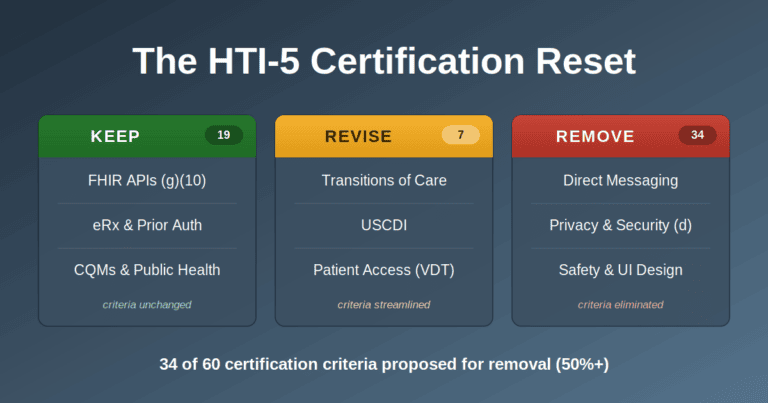
Well, it’s official. ONC (yes, it’s ONC again, more on that below) has released the HTI-5 final rule, and it is scheduled for publication in the Federal Register on October 28, 2026. Back in December we called the proposed rule a seismic reset: 34 of the 60 certification criteria proposed for removal and seven more revised. After a comment period where the industry pushed back hard, the final number is a lot smaller.
Here’s a quick recap for EHR vendors:
- 14 certification criteria removed (34 were proposed)
- 7 criteria revised
- 39 criteria untouched, including the new HTI-4 prior authorization and real time prescription benefit criteria
- All 13 privacy and security criteria stay
- The information blocking proposals are not in this rule at all
In other words, ONC listened. Not completely, but a lot more than many of us expected.
Three Dates for Your Calendar
Like the proposed rule, the final rule runs on more than one clock. Before you worry about any individual criterion, sort your product roadmap by date:
- Effective date: 60 days after publication, which works out to December 27, 2026. Most removals and revisions land here.
- January 1, 2027: A handful of removals wait for the new year, including CQM filter and the two automated measure criteria.
- January 1, 2030: This one is new. The C-CDA and Direct requirements in transitions of care were not cut outright. ONC pushed their removal out three years.
What Got Cut
Here are the 14 criteria that are leaving the program:
| Criterion | Reference | Removed as of |
|---|---|---|
| Clinical decision support (already expired) | § 170.315(a)(9) | Effective date |
| Family health history | § 170.315(a)(12) | January 1, 2027 |
| Security tags, summary of care (send) | § 170.315(b)(7) | Effective date |
| Security tags, summary of care (receive) | § 170.315(b)(8) | Effective date |
| Care plan | § 170.315(b)(9) | Effective date |
| Clinical quality measures, filter | § 170.315(c)(4) | January 1, 2027 |
| Patient health information capture | § 170.315(e)(3) | January 1, 2027 |
| Automated numerator recording | § 170.315(g)(1) | January 1, 2027 |
| Automated measure calculation | § 170.315(g)(2) | January 1, 2027 |
| Consolidated CDA creation performance | § 170.315(g)(6) | Effective date |
| Application access, patient selection | § 170.315(g)(7) | January 1, 2027 |
| Application access, all data request | § 170.315(g)(9) | January 1, 2027 |
| Direct Project | § 170.315(h)(1) | Effective date |
| Direct Project, Edge Protocol, and XDR/XDM | § 170.315(h)(2) | Effective date |
Just like the criteria the Cures Act final rule removed back in 2020, the expectation is that vendors will keep the functionality. ONC makes that point over and over in the preamble: these capabilities are “widely implemented,” so certification is no longer what keeps them in the product. Your customers are.
What Got Revised
- Transitions of care, § 170.315(b)(1). The C-CDA create, display, and Direct send and receive requirements are still coming out, but not until January 1, 2030. ONC heard the comments about how much C-CDA and Direct traffic is out there today (Oracle alone reported roughly 40 million C-CDA documents a month, and Carequality more than 1.2 billion documents exchanged monthly) and decided FHIR needs more runway. Outdated C-CDA standard references get updated on the effective date.
- Clinical information reconciliation and incorporation, § 170.315(b)(2). Proposed for removal, but saved. It becomes a functional criterion: no more required content standards, no more “simultaneous display” of two sources, and you can demonstrate reconciliation in a broader range of workflows (data from a patient, internal transfers, discharges), not just on receipt of a referral summary.
- Decision support interventions, § 170.315(b)(11). The AI “model card” is gone. The source attribute requirements in (b)(11)(iv) and (v) are removed completely, along with the intervention risk management requirements in (b)(11)(vi). Drug interaction and drug allergy checking also drops out of (b)(11)(iii). Some commenters floated keeping source attributes as product documentation only. ONC didn’t take it.
- CQM report, § 170.315(c)(3). Housekeeping only. The expired transition language comes out, and the requirements are moved up into the main paragraph. Nothing substantive changes.
- View, download, and transmit, § 170.315(e)(1). The NTP (Network Time Protocol) requirement is removed.
- Antimicrobial use and resistance reporting, § 170.315(f)(6). Revised rather than removed.
- Safety enhanced design, § 170.315(g)(3). Also proposed for removal, also saved. It becomes an attestation based requirement. (If you read our SED blog last year, good news: this just got a lot easier.)
What Survived
The biggest reversal is privacy and security. ONC proposed deleting all 13 criteria at § 170.315(d), plus the Privacy and Security Certification Framework. That was the most opposed item in the entire docket, and ONC backed off completely. It didn’t even finalize its own fallback of keeping just the audit log criteria. Everything stays for now, and ONC says it will look at “the best regulatory approach” in future rulemaking, possibly including updates to the outdated audit standard.
One interesting footnote: ONC points out that the new HTI-4 prior authorization API criteria, (g)(31) through (g)(33), and the (j)(20) and (j)(21) criteria were never added to the privacy and security framework. They may be added in a future rule. Something to keep an eye on if you’re working on HTI-4.
Other criteria that were proposed for removal or revision but stay as they are:
- Implantable device list, § 170.315(a)(14)
- Transmission to cancer registries, § 170.315(f)(4)
- Electronic case reporting, § 170.315(f)(5)
- Health care surveys, § 170.315(f)(7)
- Quality management system, § 170.315(g)(4)
- Accessibility centered design, § 170.315(g)(5)
And of course, the § 170.315(g)(10) standardized FHIR API was never on the table. That’s the whole point of the rule.
Did the Comments Make a Difference?
Short answer: yes. If you’ve ever wondered whether writing a comment letter is worth the effort, HTI-5 is your answer.
HTI5.org put together a structured analysis of 298 of the posted comment letters, and the headline is that a deregulatory rule got a negative reception. About half of the letters (151 of 298) opposed or strongly opposed it, and only about 30 percent supported it. The interesting part is who said what. The people who build the software (EHR vendors, payers, health IT companies) were mostly positive. The people who use it, and the people who answer for it (health systems, clinicians, advocacy groups, government agencies), were not. CHIME summed it up well:
Deregulation that merely shifts compliance burdens from technology vendors to providers will not achieve the Administration’s goals.
College of Healthcare Information Management Executives (CHIME)
Another surprise: Epic and Oracle Health both landed in the “strongly oppose” column, while MEDITECH, athenahealth, NextGen, and Veradigm supported the rule. The big vendors weren’t defending certification. They were objecting to the information blocking changes, which are exactly the part ONC left out of the final rule. Interesting!
Here’s how the most contested provisions turned out:
| Provision | Proposed | What commenters said | Final rule |
|---|---|---|---|
| Privacy and security, § 170.315(d)(1) through (d)(13) | Remove all 13 | The most opposed item in the docket | All 13 kept |
| Information blocking: autonomous AI “without limitation” | Finalize | Epic, PointClickCare, and the EHR Association opposed; data intermediaries in favor | Not finalized, still under review |
| TEFCA manner exception | Eliminate | Mostly supported | Not finalized, still under review |
| C-CDA and Direct in transitions of care, § 170.315(b)(1) | Remove | FHIR documents aren’t ready to carry the load | Delayed to January 1, 2030 |
| Clinical information reconciliation, § 170.315(b)(2) | Remove | Keep it | Kept as a functional criterion |
| Safety enhanced design, § 170.315(g)(3) | Remove | Keep it | Kept as an attestation |
| Quality management system, § 170.315(g)(4) | Remove | Oracle called it critical to patient safety | Kept |
| DSI model card, § 170.315(b)(11) | Remove source attributes | Split; keep them as documentation only | Removed, along with risk management |
| CQM report, § 170.315(c)(3) | Revise | Make it technology neutral (QRDA or FHIR) | Cleanup only; QRDA stays |
| CQM filter, § 170.315(c)(4) | Remove January 1, 2027 | Health centers: this is how UDS reporting works | Removed January 1, 2027 |
| Automated measure criteria, § 170.315(g)(1) and (g)(2) | Remove January 1, 2027 | Little organized opposition | Removed January 1, 2027 |
The pattern is pretty clear. Where commenters could show that removing a criterion would push cost and risk onto providers (security, C-CDA, safety), ONC backed off. Where ONC had usage data showing a criterion wasn’t pulling its weight ((c)(4), the model card), it held its ground.
Quality Measures: The Part We Watched Most Closely
First, the good news. The core of CQM certification, § 170.315(c)(1) record and export and § 170.315(c)(2) import and calculate, was never in play, and (c)(3) only got a cleanup. If your product is certified for CQMs today, that certification isn’t going anywhere.
QRDA stays. Several commenters, including the Digital Quality Implementers Community, asked ONC to make (c)(3) technology neutral so that FHIR based quality reporting could count as an alternative to QRDA. ONC’s answer was short: it didn’t propose that, so it can’t finalize it. We’d still call that a “not yet” rather than a “no,” since ONC also says it intends to prioritize FHIR APIs for “timely reporting” use cases like quality. For now, though, QRDA remains the certified path. (Our eCQM to dQM transition guide covers where the FHIR side stands.)
CQM filter is gone. § 170.315(c)(4) is removed as of January 1, 2027, as proposed. This is the criterion that requires certified health IT to filter quality results by things like race, ethnicity, sex, age, and payer. Community health centers fought hard to keep it because that’s how a lot of UDS reporting gets done. To its credit, ONC acknowledged UDS by name in its response. It removed the criterion anyway, and it brought data to back up the decision:
- 326 active Health IT Modules are certified to (c)(1), (c)(2), or (c)(3), but only 62 are certified to (c)(4).
- Less than 2 percent of MIPS eligible clinicians and less than 8 percent of hospitals reported using technology certified to (c)(4) in 2024.
- CMS has already proposed, in the CY 2027 Physician Fee Schedule, to drop (c)(4) from the CEHRT definition effective January 1, 2027.
ONC’s argument is that filtering is in EHRs because customers need it, not because certification requires it. That’s probably true for most products. But here’s the practical takeaway for health centers: after January 1, 2027, demographic filtering lives in your vendor contract, not in federal regulation. If your UDS reporting depends on it, get the commitment in writing. (See our 2026 UDS changes post and UDS reporting guide for what’s changing on the reporting side.)
Automated numerator recording and automated measure calculation are gone too. § 170.315(g)(1) and (g)(2) are removed as of January 1, 2027. Keep in mind that the Promoting Interoperability measures themselves still exist, so providers still need the numbers. What goes away is the certification testing of how your software produces them, which (as anyone who has been through (g)(2) testing knows) was no small thing. ONC says it will work with CMS to consolidate the related guidance.
Real World Testing and Insights
Two Conditions and Maintenance of Certification changes worth noting:
- Real World Testing: RWT plans are gone, and results reporting is reduced. This matches the enforcement discretion ONC announced in June 2025, so most of you have already stopped writing plans. SVAP was finalized with some modifications. (Our RWT game plan from 2021 is officially a history lesson.)
- Insights: Five measures are removed. “Use of FHIR in apps” stays, and so does “use of FHIR bulk data access,” which ONC had proposed to remove. The bulk data measure reporting start moves from July 2028 to July 2029. See our Insights Condition blog for background.
Odds and Ends
- ASTP is ONC again. The final rule removes references to the Assistant Secretary for Technology Policy and “restores” the Office of the National Coordinator. Last December we asked if they could shorten the acronyms while they were cutting red tape. Close enough!
- Information blocking is still pending. The proposals to redefine “access” and “use” to cover autonomous AI “without limitation” and to eliminate the TEFCA manner exception are not in this final rule. ONC says the proposals it didn’t address “remain under review and consideration” and may show up in a future rule. Stay tuned.
- The savings: ONC estimates $1.55 billion in present value cost savings, or $108.1 million a year, with $0 in new compliance costs for developers.
- The vision: ONC wants future certification focused on FHIR APIs that improve automation, move “beyond read only interactions,” and expand the data available for reporting. The preamble even mentions Model Context Protocol (MCP) and “super intelligence” as the kind of thing FHIR should be combined with. It will be interesting to see how this one plays out!
What This Means for DHIT Clients
For most of our partners, HTI-5 is a net positive: less testing and fewer criteria to maintain, while the parts of the program we live in every day stay put.
- Quality measures: CQMsolution certification covers the CQM criteria that didn’t change, (c)(1) through (c)(3). QRDA stays the certified reporting format, and we’re ready for FHIR when it becomes an option.
- UDS: CQMsolution supports UDS reporting today, independent of whether your EHR keeps a (c)(4) certification. If you’re a health center or a vendor serving them, take a look at our UDS Platform.
- FHIR: With (g)(7) and (g)(9) going away, (g)(10) is the API criterion that matters. Our Dynamic FHIR API is built for exactly that.
- Certification: Fewer criteria doesn’t mean no criteria. SED attestation, privacy and security, Insights, and the HTI-4 APIs all still need attention.
At DHIT, we welcome your feedback on requirements and are eager to assist with certification. Our expert consulting and bolt on modules have paved the way for many successful EHR vendor certifications. Please contact us for additional information, and we’ll walk through the final rule with you, criterion by criterion.
Get new posts by email
We write about CMS and ONC rules, quality measures and interoperability. Choose what you want to hear about.