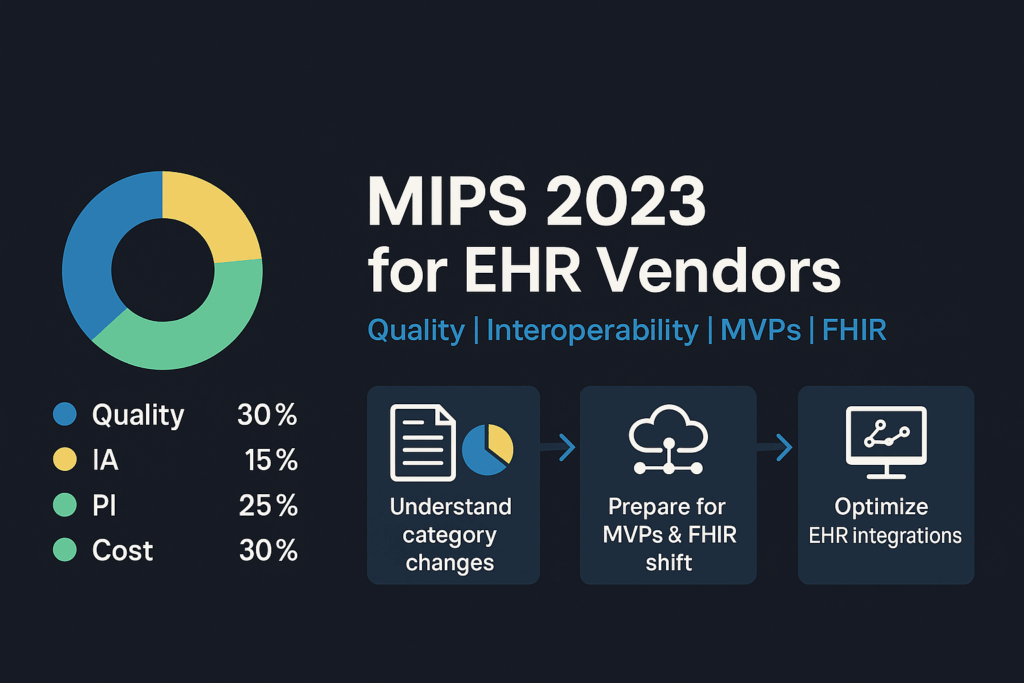
For 2023 CMS fine-tunes the MIPS program and, in particular, makes some changes to the quality reporting component while slowly transitioning towards its two major quality reporting objectives:
- MIPS Value Pathways (MVPs), and
- The migration of Clinical Quality Measures to FHIR
MVPs Introduction
MVPs are CMS’ initiative to tailor the MIPS program to be more relevant to a clinicians area of practice. They are optional for 2023. Each MVP has a limited set of measures that focus on a particular medical specialty (e.g. Cardiology has an “Advancing Care for Heart Disease MVP) or medical condition (e.g. cancer). Since we are quality measure experts, we will focus on Quality reporting requirements for 2023 and gotchas for 2022 Quality reporting.
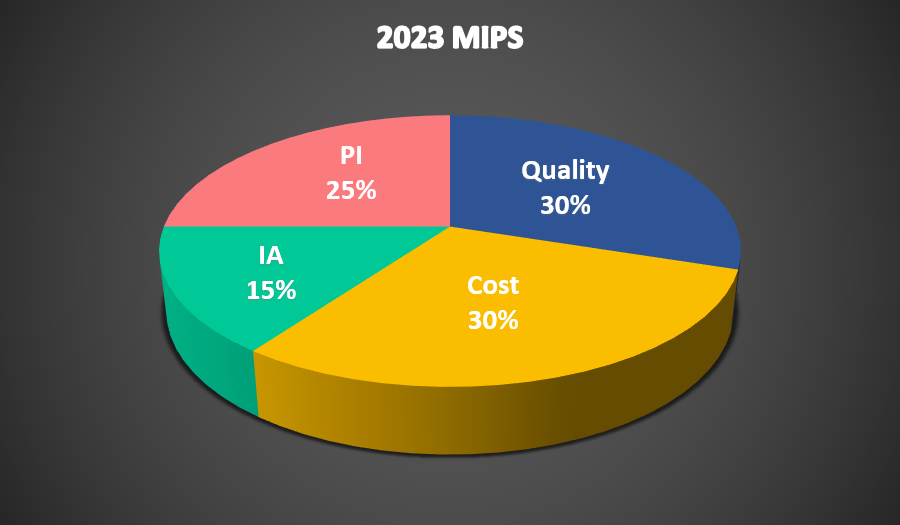
Category Weighting and Performance Thresholds
Overall MIPS thresholds remain the same as for 2022. To avoid a penalty, you must score at least 75 points. Non-participation or a low score can result in a 9% penalty on Medicare reimbursement. Since the MIPS program is budget-neutral, the maximum bonus is 9%, to be applied to your 2025 Medicare reimbursement.
Quality Measure Reporting
For 2023, there are nine new measures, including one administrative claims measure, one composite measure, five high-priority measures, and two patient-reported outcomes measures. A couple of notable new measures include Psoriasis and Dermatitis.
In the 2022 reporting year, 200 CQMs were available. For 2023, there will be 198 CQMs to choose from, as some old measures were removed and some new ones added:
New Quality Measures for 2023:
| Quality # | New Measure | eCQM ID | NQF | Measure Description |
|---|---|---|---|---|
| 485 | Psoriasis – Improvement in Patient-Reported Itch Severity | N/A | N/A | The percentage of patients, aged 18 years and older, with a diagnosis of psoriasis where at an initial (index) visit have a patient reported itch severity assessment performed, score greater than or equal to 4, and who achieve a score reduction of 2 or more points at a follow up visit. |
| 486 | Dermatitis – Improvement in Patient-Reported Itch Severity | N/A | N/A | The percentage of patients, aged 18 years and older, with a diagnosis of dermatitis where at an initial (index) visit have a patient reported itch severity assessment performed, score greater than or equal to 4, and who achieve a score reduction of 2 or more points at a follow up visit. |
| 487 | Screening for Social Drivers of Health | N/A | N/A | Percent of patients 18 years and older screened for food insecurity, housing instability, transportation needs, utility difficulties, and interpersonal safety. |
| 488 | Kidney Health Evaluation | CMS951v1 | N/A | Percentage of patients aged 18-75 years with a diagnosis of diabetes who received a kidney health evaluation defined by an Estimated Glomerular Filtration Rate (eGFR) AND Urine Albumin-Creatinine Ratio (uACR) within the measurement period. |
| 489 | Adult Kidney Disease: Angiotensin Converting Enzyme (ACE) Inhibitor or Angiotensin Receptor Blocker (ARB) Therapy | N/A | 1662 | Percentage of patients aged 18 years and older with a diagnosis of chronic kidney disease (CKD) (Stages 1-5, not receiving Renal Replacement Therapy (RRT)) and proteinuria who were prescribed ACE inhibitor or ARB therapy within a 12-month period. |
| 490 | Appropriate Intervention of Immune-Related Diarrhea and/or Colitis in Patients Treated with Immune Checkpoint Inhibitors | N/A | N/A | Percentage of patients, aged 18 years and older, with a diagnosis of cancer, on immune checkpoint inhibitor therapy, and grade 2 or above diarrhea and/or grade 2 or above colitis, who have immune checkpoint inhibitor therapy held and corticosteroids or immunosuppressants prescribed or administered. |
| 491 | Mismatch Repair (MMR) or Microsatellite Instability (MSI) Biomarker Testing Status in Colorectal Carcinoma, Endometrial, Gastroesophageal, or Small Bowel Carcinoma | N/A | 3661 | Percentage of surgical pathology reports for primary colorectal, endometrial, gastroesophageal or small bowel carcinoma, biopsy or resection, that contain impression or conclusion of or recommendation for testing of mismatch repair (MMR) by immunohistochemistry (biomarkers MLH1, MSH2, MSH6, and PMS2), or microsatellite instability (MSI) by DNA-based testing status, or both. |
| 492 | Risk-Standardized Acute Cardiovascular-Related Hospital Admission Rates for Patients with Heart Failure under the Merit-based Incentive Payment System | N/A | 3612 | Annual risk-standardized rate of acute, unplanned cardiovascular-related admissions among Medicare Fee-for-Service (FFS) patients aged 65 years and older with heart failure (HF) or cardiomyopathy. |
| 493 | Adult Immunization Status | N/A | 3620 | Percentage of patients 19 years of age and older who are up-to-date on recommended routine vaccines for influenza; tetanus and diphtheria (Td) or tetanus, diphtheria and acellular pertussis (Tdap); zoster; and pneumococcal. |
Retired Measures:
| Quality # | Retired Measure | eCQM ID | NQF | Measure Description |
|---|---|---|---|---|
| 076 | Prevention of Central Venous Catheter (CVC) - Related Bloodstream Infections | N/A | 2726 | Percentage of patients, regardless of age, who undergo central venous catheter (CVC) insertion for whom CVC was inserted with all elements of maximal sterile barrier technique, hand hygiene, skin preparation and, if ultrasound is used, sterile ultrasound techniques followed. |
| 119 | Diabetes: Medical Attention for Nephropathy | CMS134v10 | 0062 | The percentage of patients 18-75 years of age with diabetes who had a nephropathy screening test or evidence of nephropathy during the measurement period. |
| 258 | Rate of Open Repair of Small or Moderate Non-Ruptured Infrarenal Abdominal Aortic Aneurysms (AAA) without Major Complications (Discharged to Home by Post-Operative Day #7) | N/A | N/A | Percent of patients undergoing open repair of small or moderate sized non-ruptured infrarenal abdominal aortic aneurysms (AAA) who do not experience a major complication (discharge to home no later than post-operative day #7). |
| 265 | Biopsy Follow-Up | N/A | N/A | Percentage of new patients whose biopsy results have been reviewed and communicated to the primary care/referring physician and patient. |
| 323 | Cardiac Stress Imaging Not Meeting Appropriate Use Criteria: Routine Testing After Percutaneous Coronary Intervention (PCI) | N/A | N/A | Percentage of all stress single-photon emission computed tomography (SPECT) myocardial perfusion imaging (MPI), stress echocardiogram (ECHO), cardiac computed tomography angiography (CCTA), and cardiovascular magnetic resonance (CMR) performed in patients aged 18 years and older routinely after percutaneous coronary intervention (PCI), with reference to timing of test after PCI and symptom status. |
| 375 | Functional Status Assessment for Total Knee Replacement | CMS66v10 | N/A | Percentage of patients 18 years of age and older who received an elective primary total knee arthroplasty (TKA) and completed a functional status assessment within 90 days prior to the surgery and in the 270-365 days after the surgery. |
| 425 | Photodocumentation of Cecal Intubation | N/A | N/A | The rate of screening and surveillance colonoscopies for which photodocumentation of at least two landmarks of cecal intubation is performed to establish a complete examination. |
| 455 | Percentage of Patients Who Died from Cancer Admitted to the Intensive Care Unit (ICU) in the Last 30 Days of Life (lower score – better) | N/A | 0213 | Percentage of patients who died from cancer admitted to the ICU in the last 30 days of life. |
| 460 | Back Pain After Lumbar Fusion | N/A | N/A | For patients 18 years of age or older who had a lumbar fusion procedure, back pain is rated by the patient as less than or equal to 3.0 OR an improvement of 5.0 points or greater on the Visual Analog Scale (VAS) Pain scale at one year (9 to 15 months) postoperatively. |
| 469 | Functional Status After Lumbar Fusion | N/A | N/A | For patients 18 years of age and older who had a lumbar fusion procedure, functional status is rated by the patient as less than or equal to 22 OR an improvement of 30 points or greater on the Oswestry Disability Index (ODI version 2.1a) at one year (9 to 15 months) postoperatively. |
| 473 | Leg Pain After Lumbar Fusion | N/A | N/A | For patients 18 years of age or older who had a lumbar fusion procedure, leg pain is rated by the patient as less than or equal to 3.0 OR an improvement of 5.0 points or greater on the Visual Analog Scale (VAS) Pain scale at one year (9 to 15 months) postoperatively. |
CQM 110 Status Clarification:
| Quality # | Measure | eCQM ID | NQF | Measure Description |
|---|---|---|---|---|
| 110 | Preventive Care and Screening: Influenza Immunization | CMS147v11 | 0041e / 0041 | Percentage of patients aged 6 months and older seen for a visit between October 1 and March 31 who received an influenza immunization OR who reported previous receipt of an influenza immunization. |
It has been removed as a measure for traditional MIPS (Quality # 110) but retained as a measure for ACOs and as an eCQM for MVPs.
Truncated and Suppressed Quality Measures – Flashback to 2022
CMS recognized that some quality measures were impacted by the October 2022 ICD-10 code update. Since quality measure specifications can’t be updated during the current performance period, these measures will be suppressed (eCQMs) or truncated (MIPS CQMs and claims-based measures). What does that mean to you?
Suppressed CQMs:
- CMS will exclude the points from this measure – the denominator is reduced by 10 points and the numerator is excluded from scoring.
- If a suppressed measure is one of the 6 CQMs you submit, your Quality category denominator will be reduced by 10 points. Out of the remaining measures you submit, CMS will use your highest scoring outcome/high priority measure and 4 remaining highest scoring measures.
| Quality # | eCQM ID | Quality Description |
|---|---|---|
| 005 | CMS135v10 | Heart Failure (HF): Angiotensin Converting Enzyme (ACE) Inhibitor or Angiotensin Receptor Blocker (ARB) or Angiotensin Receptor-Neprilysin Inhibitor (ARNI) Therapy for Left Ventricular Systolic Dysfunction (LVSD) |
| 113 | CMS130v10 | Colorectal Cancer Screening |
| 134 | CMS2v11 | Preventive Care and Screening: Screening for Depression and Follow-Up Plan |
| 236 | CMS165v10 | Controlling High Blood Pressure |
| 238 | N/A | Use of High-Risk Medications in Older Adults |
| 239 | CMS155v10 | Weight Assessment and Counseling for Nutrition and Physical Activity for Children/Adolescents |
| 281 | CMS149v10 | Dementia: Cognitive Assessment |
| 326 | N/A | Atrial Fibrillation and Atrial Flutter: Chronic Anticoagulation Therapy |
| 366 | CMS136v11 | Follow-Up Care for Children Prescribed ADHD Medication (ADD) |
Truncated CQMS:
- For these measures CMS will only use data from the first 9 months of the year (prior to October 1, 2022). Only data from January through the end of September will be counted.
| Quality # | Quality Description |
|---|---|
| 259 | Rate of Endovascular Aneurysm Repair (EVAR) of Small or Moderate Non-Ruptured Infrarenal Abdominal Aortic Aneurysms (AAA) without Major Complications (Discharged to Home by Post-Operative Day #2) |
| 282 | Dementia: Functional Status Assessment |
| 283 | Dementia Associated Behavioral and Psychiatric Symptoms Screening and Management |
| 286 | Dementia: Safety Concern Screening and Follow-Up for Patients with Dementia |
| 288 | Dementia: Education and Support of Caregivers for Patients with Dementia |
| 383 | Adherence to Antipsychotic Medications For Individuals with Schizophrenia |
| 415 | Emergency Medicine: Emergency Department Utilization of CT for Minor Blunt Head Trauma for Patients Aged 18 Years and Older |
| 416 | Emergency Medicine: Emergency Department Utilization of CT for Minor Blunt Head Trauma for Patients Aged 2 Through 17 Years |
| 465 | Uterine Artery Embolization Technique: Documentation of Angiographic Endpoints and Interrogation of Ovarian Arteries |
Quality Scoring Changes
Prior to 2023, CQMs had a 3-point floor, so if you reported on a CQM, 3 points was the minimum score per measure. Except for small practices (<16 clinicians) this is no longer the case. Measures:
- With a benchmark,
- Meeting the 20-case minimum, and
- Data completeness
Will be scored on a 1-10 scale. Measures failing any of these criteria will earn 0 points for larger practices and 3 points for small practices.
DHIT Solutions for MIPS Compliance
As outlined in our earlier discussion of MVPs, CMS is transitioning toward a specialty-focused approach for the Quality Payment Program. At Dynamic Health IT (DHIT), we are committed to positioning our Strategic Partners ahead of this transformation through our comprehensive Qualified Registry and our ONC-certified Cures Update 2023 version of CQMsolution.
We support quality measures for various medical specialties, including radiology, oncology, behavioral health, primary care and others. Our annual CQMsolution updates keep you up-to-date with measure changes. Stay tuned for future blogs on MVPs and FHIR-based CQMs.